This review list is offered to educate you on the subject of this document and to aid you in its preparation. Employee financing has become a widely accepted practice in a wide variety of businesses. It enables the Temporary Employer to use Employees at will without being subject to hiring, firing, or reporting regulations. Additionally, this maintains the temporary employees’ status as suppliers to the employer, who stays a client.
- Produce duplicates. Obtain your Federal identification number and Social Security
number to ensure that you are covered under this arrangement.


Employee Lending Agreement
In cases where you as an employer, needs to acquire of employees to finish some particular work, but said employee/s is/are already under another company, an employee lending agreement shall be signed between you and the employers of the other company. This contract will make you the temporary employer and will give you the power to use the employees at will without having to fire or hire, and report requirements associated with it. This also secures the position of temporary employees as a customer and supplier to the employer.
This contract shall include employment specifics as to the position of the temporary employee at an agreed rate of compensation. The contract will also include the date of start and end of employment of temporary employee at your company. This contract will also include temporary employee reimbursement and compensation insurance both agreed upon by both parties.
Contract is signed by employer, temporary employer, and employee on date of agreement. Employee lending is used by companies in circumstances where there is a surplus of employees due to seasonal workload also allowing the employer to lower costs. Large companies often practice this but may also present a significant number of risks where the employee may refuse to work for the temporary employer due to a number of reasons. Also, given that the employee does great at his position under the temporary employer, the temporary employer may present a better offer for permanent employment to the employee. These risks must be understood by both employers. This agreement is also used if termination of employees is to be avoided.
Employee Lending Agreement
Employee Lending Agreement
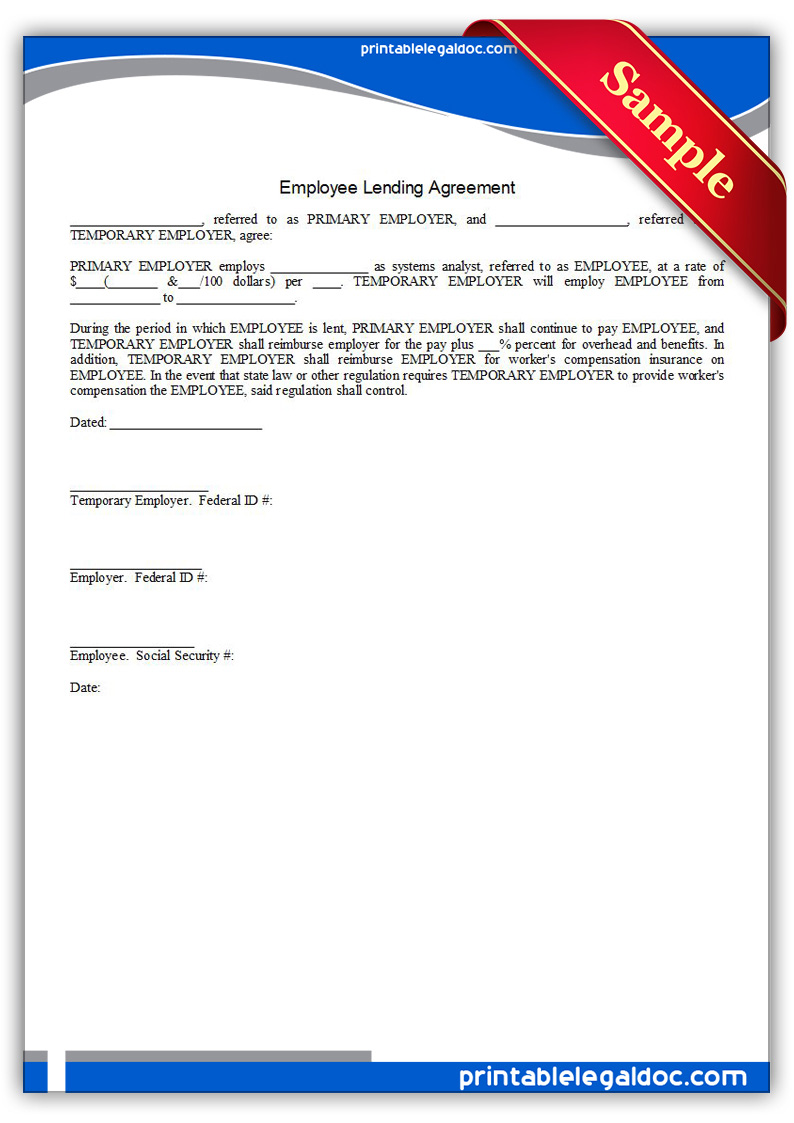
___________________, referred to as PRIMARY EMPLOYER, and ___________________, referred to as TEMPORARY EMPLOYER, agree:
PRIMARY EMPLOYER employs ______________ as systems analyst, referred to as EMPLOYEE, at a rate of $____(_______ &___/100 dollars) per ____. TEMPORARY EMPLOYER will employ EMPLOYEE from _____________ to _________________.
During the period in which EMPLOYEE is lent, PRIMARY EMPLOYER shall continue to pay EMPLOYEE, and TEMPORARY EMPLOYER shall reimburse employer for the pay plus ___% percent for overhead and benefits. In addition, TEMPORARY EMPLOYER shall reimburse EMPLOYER for worker’s compensation insurance on EMPLOYEE. In the event that state law or other regulation requires TEMPORARY EMPLOYER to provide worker’s compensation the EMPLOYEE, said regulation shall control.
Dated: ______________________
____________________
Temporary Employer. Federal ID #:
___________________
Employer. Federal ID #:
__________________
Employee. Social Security #:Date:
Employee Lending Agreement
Review ListThis review list is provided to inform you about this document in question and assist you in its preparation. Employee lending has become a standard practice in many industries. It lets the Temporary Employer use Employees at will without having hiring, firing, and reporting requirements associated with it. This also keeps the temporary employees in a position as suppliers to the employer, who remains a customer.
1. Make duplicate copies. Be sure to get the Federal ID and Social Security numbers so you are protected under this arrangement.
Frequently Asked Questions
What is an employee lending agreement?
An employee lending agreement is a contract between a primary employer and a temporary employer under which an employee is lent to the temporary employer for a specified period. The primary employer continues to pay the employee, and the temporary employer reimburses the primary employer for the pay plus an agreed percentage for overhead and benefits. The agreement also addresses reimbursement for worker's compensation insurance.
Who are the parties involved in an employee lending agreement?
The parties are the primary employer, the temporary employer, and the employee. The primary employer is the original employer of the employee, while the temporary employer is the entity to which the employee is lent. The employee is typically identified by name and social security number in the agreement.
What does the temporary employer pay for under an employee lending agreement?
The temporary employer reimburses the primary employer for the employee's pay plus a specified percentage for overhead and benefits. Additionally, the temporary employer reimburses the primary employer for worker's compensation insurance on the employee. If state law or regulation requires the temporary employer to provide worker's compensation, that regulation controls.
Does the primary employer continue to pay the employee during the lending period?
Yes, during the period in which the employee is lent, the primary employer shall continue to pay the employee. The temporary employer then reimburses the primary employer for that pay plus an additional percentage for overhead and benefits. This arrangement ensures the employee remains on the primary employer's payroll.
What happens if state law requires the temporary employer to provide worker's compensation?
If state law or other regulation requires the temporary employer to provide worker's compensation to the employee, that regulation shall control. This means the temporary employer must comply with the legal requirement, even if the agreement states otherwise. The agreement defers to state law or regulation in such cases.
What information is required to complete an employee lending agreement?
The agreement requires the names of the primary employer and temporary employer, the employee's name and social security number, the employee's job title (e.g., systems analyst), the pay rate, and the lending period start and end dates. It also requires the percentage for overhead and benefits, the date of the agreement, and federal ID numbers for both employers. The employee's social security number and date are also included.
How is the employee's pay rate determined in an employee lending agreement?
The employee's pay rate is specified in the agreement as a dollar amount per specified period (e.g., per hour, week, or month). The primary employer continues to pay this rate during the lending period. The temporary employer reimburses the primary employer for this pay plus an additional percentage for overhead and benefits.
What is the purpose of the overhead and benefits percentage in an employee lending agreement?
The overhead and benefits percentage is an additional amount that the temporary employer must reimburse the primary employer on top of the employee's pay. This percentage covers the costs associated with overhead and benefits that the primary employer continues to incur while the employee is lent. The specific percentage is agreed upon by the parties and stated in the agreement.
Can an employee lending agreement be used for any type of employee?
The agreement is designed for lending an employee to another employer for a temporary period. The example in the document specifies a systems analyst, but the agreement can be adapted for other roles by specifying the job title. The agreement does not restrict the type of employee, but the terms must be agreed upon by the parties.
What is the lending period in an employee lending agreement?
The lending period is the specified duration during which the employee will be employed by the temporary employer. It is defined by a start date and an end date in the agreement. During this period, the primary employer continues to pay the employee, and the temporary employer reimburses the primary employer as outlined in the agreement.


