This review list is being supplied to you in order to inform you about the document in question and to assist you in preparing it for submission. Business trusts are often established for the purpose of obtaining tax and associated benefits.
- Make numerous copies of the document. Keep one in your house as a backup. One should be kept with the transaction file. Give one to each person who will be signing the document.
Business Trust
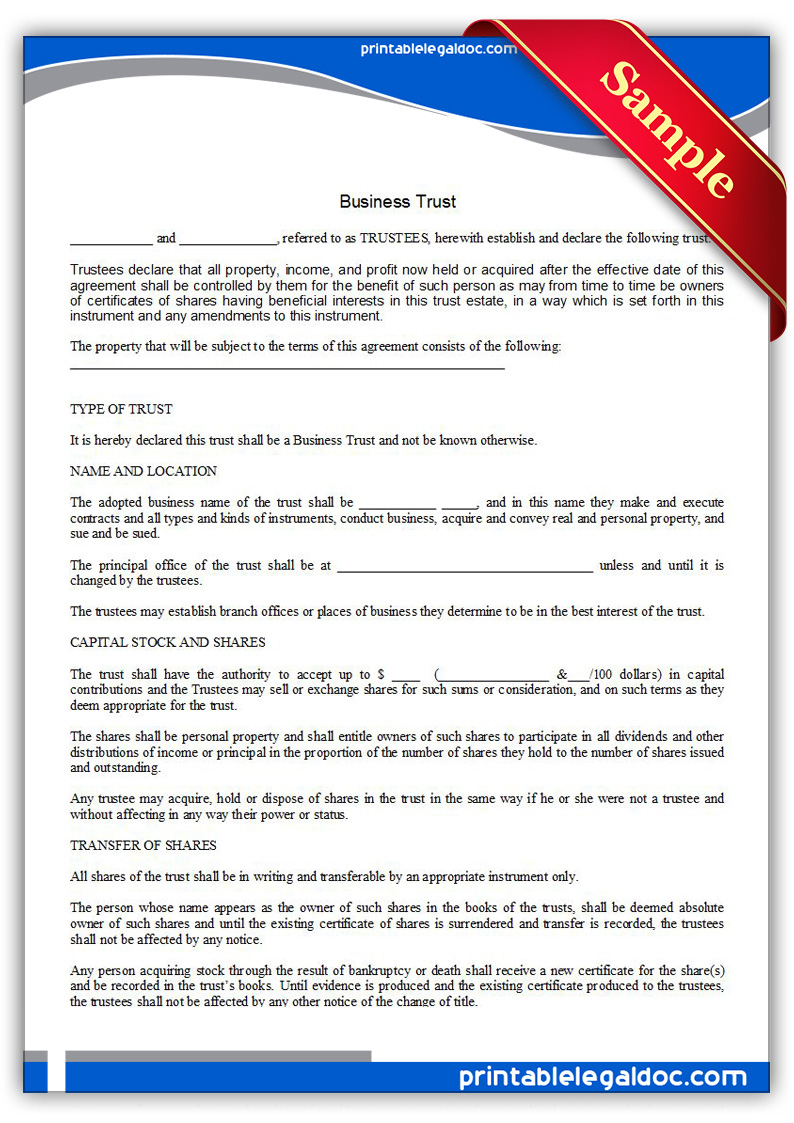
Business Trust
____________ and ______________, referred to as TRUSTEES, herewith establish and declare the following trust:
Trustees declare that all property, income, and profit now held or acquired after the effective date of this agreement shall be controlled by them for the benefit of such person as may from time to time be owners of certificates of shares having beneficial interests in this trust estate, in a way which is set forth in this instrument and any amendments to this instrument.
The property that will be subject to the terms of this agreement consists of the following:
_______________________________________________________________
TYPE OF TRUSTIt is hereby declared this trust shall be a Business Trust and not be known otherwise.
NAME AND LOCATION
The adopted business name of the trust shall be ___________ _____, and in this name they make and execute contracts and all types and kinds of instruments, conduct business, acquire and convey real and personal property, and sue and be sued.
The principal office of the trust shall be at _____________________________________ unless and until it is changed by the trustees.
The trustees may establish branch offices or places of business they determine to be in the best interest of the trust.
CAPITAL STOCK AND SHARES
The trust shall have the authority to accept up to $ ____ (________________ &___/100 dollars) in capital contributions and the Trustees may sell or exchange shares for such sums or consideration, and on such terms as they deem appropriate for the trust.
The shares shall be personal property and shall entitle owners of such shares to participate in all dividends and other distributions of income or principal in the proportion of the number of shares they hold to the number of shares issued and outstanding.
Any trustee may acquire, hold or dispose of shares in the trust in the same way if he or she were not a trustee and without affecting in any way their power or status.
TRANSFER OF SHARES
All shares of the trust shall be in writing and transferable by an appropriate instrument only.
The person whose name appears as the owner of such shares in the books of the trusts, shall be deemed absolute owner of such shares and until the existing certificate of shares is surrendered and transfer is recorded, the trustees shall not be affected by any notice.
Any person acquiring stock through the result of bankruptcy or death shall receive a new certificate for the share(s) and be recorded in the trust’s books. Until evidence is produced and the existing certificate produced to the trustees, the trustees shall not be affected by any other notice of the change of title.
In the event of a death of one of the shareholders the shareholder’s heirs, legatees, or legal representatives of the descendent shall succeed to his or her rights.
LOSS OR DESTRUCTION OF CERTIFICATE
A new certificate may be issued in place of an old one upon provision of a surety bond or upon such other terms and conditions as are proper and necessary.
INSPECTION OF STOCK RECORDSThe stock books shall be open for inspection by any shareholder or their representative or agent at all reasonable times.
DIVIDENDS
Trustees may distribute net earnings received by them in their own discretion, and when they deem it to be proper and advisable.
RIGHTS OF SHAREHOLDERS
The rights of shareholders and transferees and other persons becoming entitled to heirs of the trust shall be subject to the all the terms and conditions of this declaration of trust.
No shareholder shall have the right to manage or control the property, affairs, or business of the trust, or any power to control trustees in these respects or the right to an accounting or partition of the trust property during the duration of the trust.
LIABILITIES OF SHAREHOLDERS
Shareholders shall not be liable for any assessment, and trustees shall have no power to bind the shareholders personally.
No amendment shall be made to this declaration increasing the liability of the shareholder without the written consent of all the shareholders.
Every document and correspondence executed by the trustees shall have in writing a stipulation which holds the shareholders not liable for any debt, demand, or liability incurred in connection with the document. However, failure of the stipulation to appear does not render any shareholder personally liable.
SHAREHOLDERS MEETINGS AND ELECTIONS
Shareholders shall meet annually on the anniversary date of the declaration of this trust, or if said day is a legal holiday, on the next business day thereafter, at the principal office of the trust, or such other place as the Trustees may establish.
The Trustees may call special meetings of the shareholders at any time. Trustees are responsible for notifying all the shareholders of any special meeting and its nature of business and the meeting shall pertain only to the business specified in the notice of special meeting.
Notice will be deemed properly delivered if mailed or delivered to the shareholder’s address contained in the trust’s books.
The President named by the trustees shall preside at all the meetings. The shareholders shall be entitled to one vote per share and may vote by proxy. Thirty-three per cent of all outstanding shares shall constitute a quorum.
NUMBER, ELECTION, AND TENURE OF TRUSTEES
There shall be ___ trustees. The term of any trustee and their successors shall be for a term of one year, or until their successors are elected.
The death, resignation, incapacity, or removal of any trustee shall not terminate this trust.
Any vacancy shall be filed by the remaining trustees until the end of term. New trustees shall be elected yearly by the shareholders at the annual meetings.
A Trustee may be removed by a majority vote of the other trustees when they deem it is necessary and appropriate to do so. Written notification of any such vote shall be given to each trustee at least 15 days prior to the meeting, but no such notice is necessary for regular meetings of trustees.
MEETINGS OF TRUSTEES
Meetings for the trustees shall be held at regular intervals to be established by the trustees. After the election of trustees provided for herein the trustees shall hold an initial meeting at which time they shall establish the time for meetings. A majority of the trustees shall constitute a quorum, and an absent trustee’s vote shall not be necessary to carry out any matter voted on at a meeting which holds a quorum.
WRITTEN REPORTS BY TRUSTEES
A written report shall be prepared annually showing operations during the preceding fiscal year, receipts, disbursements, and earnings, and the assets and conditions of the trust estate.
OFFICERS AND AGENTSTrustees shall appoint from among their number a President, Treasurer, and Secretary and shall perform such duties which are characteristic with that position. The terms and conditions of the positions shall be set forth by the trustees. The removal of a trustee from any such a position shall not affect his or her status as a trustee unless voted on otherwise.
COMPENSATION OF TRUSTEES
Trustees shall be compensated as they deem reasonable and proper. They shall fix the compensation, if any, of all officers and agents appointed by them.
GENERAL FUNCTIONS AND POWERS OF THE TRUSTEES
Trustees hold legal title, as if they were absolute owners, to all the property at any time belonging to the trust and have absolute control of such property subject to the limitation in this trust. Trustees also have the right to acquire property for the trust as they see proper and necessary to benefit the trust.
Trustees may sue and be sued and prosecute and defend any and all actions affecting the trust or its business or property, either in the name of the trust or their own names.
Trustees may adopt and enforce such bylaws or rules and regulations, not consistent with the provisions of this instrument they deem to be expedient.
APPLICATION OF TRUST FUNDS
Any action or thing carried out by a trustee with authority from trustees, officers, or agents shall be deemed to be within the purposes of this trust and within the powers of the trustees.
LIABILITY OF TRUSTEES
A trustee shall only be responsible for their own actions and not that of the trustees, but shall not be liable for any negligence or error in judgment, or for any act or omission, except for his or her own willful breach of trust.
A trustee shall not be required to give any bond or surety to secure the performance of the trust.
Every act or thing done or omitted by a trustee shall be in the interest of the trust and for his or her own interest.
A trustee shall not be personally liable for an act or duty carried out on behalf of the trust and a stipulation to this effect may be inserted into any document and an omission of such a stipulation shall not deem a trustee personally responsible. Any claim against a trustee who acted in the interest of the trust shall be against the property of the trust and not the trustee personally. A trustee is indemnified by and reimbursed from any personal liability, loss, or damage incurred or suffered while performing any act or duty authorized or permitted by the declaration of trust or any amendment to this declaration: but such indemnity shall be limited to the trust estate.
AMENDMENTS
This document may be amended, except in regards to the liability of the shareholders, with the consent of the owners of at least 66% of the shares. All shareholders must be notified of any meeting which holds such a matter, at the address held in the trust’s books.
DURATION AND TERMINATION
This trust shall last for a period of 10 years from the date of this instrument, unless terminated earlier.
This trust may be terminated by the trustee with the consent of the owners of at least 66% of the shares. All shareholders must be notified of any meeting which holds such a matter, at the address held in the trust’s books.
On the termination of this trust by any cause, trustees shall liquidate the trust estate, wind up the affairs of the trust, and dispose of its property and assets at public or private sales, and, after discharging all legal obligations of the trust, shall distribute the proceeds among the shareholders in proportion to their interest.
Dated: ________________________
_________________________________
TRUSTEE_________________________________
TRUSTEE_________________________________
TRUSTEE
Business Trust
Review ListThis review list is provided to inform you about this document in question and assist you in its preparation. Business trusts are generally set up for tax and related benefits.
1. Make multiple copies. Keep one in your home safe. Keep one with the transaction file. Give one to each signatory.
Frequently Asked Questions
What is a business trust?
A business trust is a legal arrangement in which trustees hold and manage property for the benefit of certificate holders who own beneficial interests in the trust estate. According to the article, the trust is declared to be a Business Trust and not known otherwise. The trustees control all property, income, and profit for the benefit of the shareholders.
How is a business trust formed?
A business trust is formed when trustees establish and declare a trust through a legal instrument. The article states that the trustees declare that all property, income, and profit now held or acquired after the effective date shall be controlled by them for the benefit of certificate holders. The trust instrument sets forth the terms and any amendments.
Who are the trustees in a business trust?
The trustees are the individuals or entities named in the trust agreement who are responsible for managing the trust property. The article refers to them as the parties who establish and declare the trust. They control the property, income, and profit for the benefit of the certificate holders.
What is the role of certificate holders in a business trust?
Certificate holders are the owners of certificates of shares that represent beneficial interests in the trust estate. The article states that the trustees control the property for the benefit of such persons as may from time to time be owners of these certificates. They do not directly manage the trust but hold a beneficial interest.
What property is included in a business trust?
The property subject to the business trust consists of all property, income, and profit now held or acquired after the effective date of the agreement. The article also includes a blank line where specific property can be listed. The trustees control this property for the benefit of the certificate holders.
What is the legal name of a business trust?
The legal name of a business trust is the adopted business name specified in the trust instrument. According to the article, the trustees adopt a business name under which they make and execute contracts, conduct business, acquire and convey real and personal property, and sue and be sued. The name is chosen by the trustees and stated in the agreement.
Where is the principal office of a business trust located?
The principal office of a business trust is located at the address specified in the trust instrument. The article states that the principal office shall be at a designated place unless and until it is changed by the trustees. The trustees may also establish branch offices or places.
Can a business trust sue and be sued?
Yes, a business trust can sue and be sued in its adopted business name. The article explicitly states that in the business name, the trustees make and execute contracts and all types and kinds of instruments, conduct business, acquire and convey real and personal property, and sue and be sued. This gives the trust the ability to engage in legal actions.
What types of contracts can a business trust execute?
A business trust can execute all types and kinds of instruments and contracts in its adopted business name. The article states that the trustees make and execute contracts and all types and kinds of instruments. This allows the trust to conduct business and acquire and convey real and personal property.
Can a business trust establish branch offices?
Yes, the trustees may establish branch offices or places as needed. The article states that the trustees may establish branch offices or places, in addition to the principal office. This allows the trust to operate in multiple locations.


