

This review list is intended to educate you about the content of this document and to guide you in its preparation.
- Copies of this letter should be sent to all known and suspected financial institutions,
including banks, brokerage firms, private corporations, and other relevant institutions that are known to have or may have the Decedent’s accounts. Consider sending duplicate requests to any known offices with whom the decedent may have dealt if you are dealing with multi-branch or multi-state organizations (e.g., Merrill Lynch might have an account in Boston; but you know he also lived in Sarasota, Florida for part of the year; you should probably send a letter to the Sarasota office too, just to be prudent and exercise your proper duties as a fiduciary). This apparently basic process may be quite beneficial for estates, since it can uncover previously unknown assets such as old retirement accounts, investments in private firms, and the like.
- Additionally, as suggested in the preceding letter, you should compile a list of financial
contacts the Decedent had. Because these people travel about a lot in their careers, learning who they are and maybe chatting with them may lead you to some hidden asset treasure at the company these people have left or are presently working by. With them, open-ended talks frequently produce unexpectedly excellent outcomes. Additionally, chatting with some of the Decedent’s former friends might provide insight into how he or she handled his or her financial affairs (e.g., orderly, disorderly, tight, loose, speculative, and so on and so on). These chats may also lead you to places, hobbies, or other channels where Decedent may have deposited some money or investments that have yielded outcomes that were unforeseen by Decedent but are now beneficial to the Estate. Keep a written record of all phone interactions and written communications. A well-written record might be examined along the way to spark more ideas on previous acquaintances when new information becomes available.
- Print several copies of this letter. Consult family members, particularly heirs, for advice
on which options to pursue. Brothers and sisters are particularly valuable because they may know more about what the Decedent did with his or her assets in their youth and, if the Decedent’s spouse is also deceased, may know more about the assets he or she may have had or would have influenced the Decedent to acquire and hold (e.g., stock in his or her brother’s company).
- Include a self-addressed stamped envelope with your letter and follow up with a phone
call. Once again, follow-ups in this area may be really beneficial for an estate. Include a copy of the “Letters of Appointment” or “Letters of Administration” with each piece of letters that you send out, if relevant. The more formal your documents appear, the more fruitful your efforts will be.
- In practice, the greater the anticipated Estate, the more valuable the aforementioned
investigative rather than administrative actions will be. Additionally, the more speculative or entrepreneurial the Decedent was, the more likely they were to hold assets in unexpected locations.
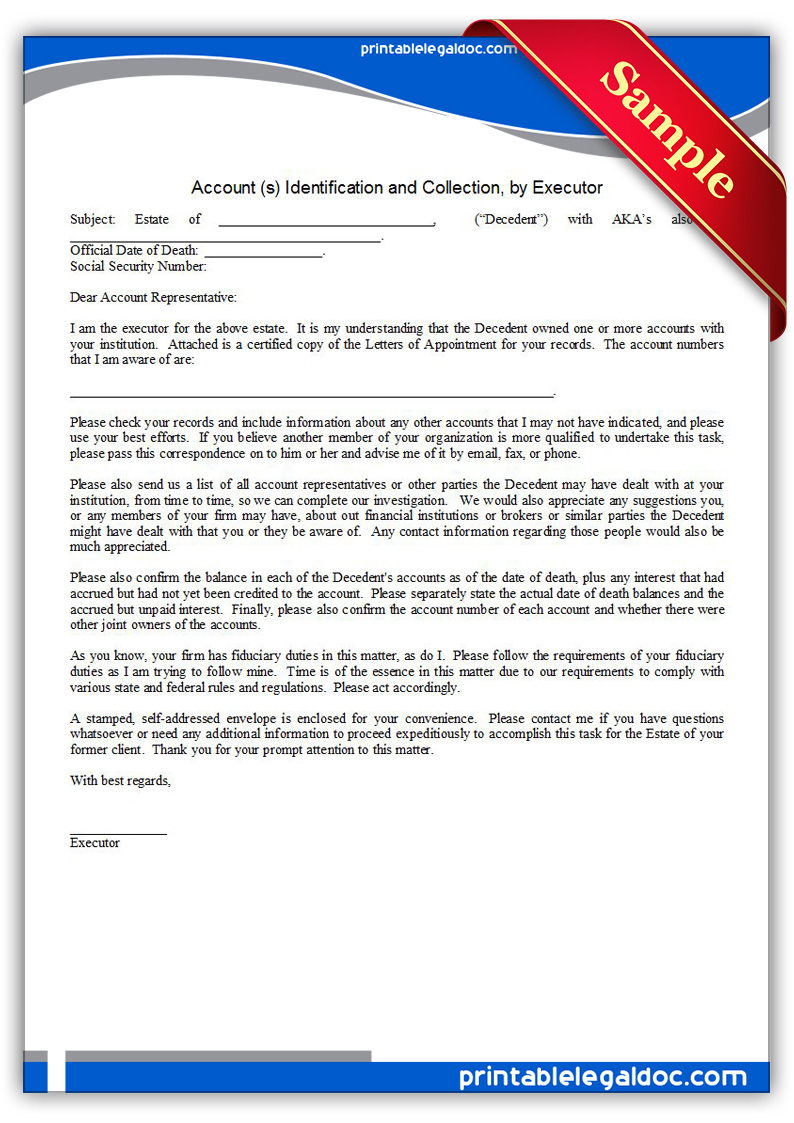
Account Identification & Collection, By Executor
Account (s) Identification and Collection, by Executor
Subject: Estate of _______________________________, (“Decedent”) with AKA’s also of _____________________________________________.
Official Date of Death: _________________.
Social Security Number:Dear Account Representative:
I am the executor for the above estate. It is my understanding that the Decedent owned one or more accounts with your institution. Attached is a certified copy of the Letters of Appointment for your records. The account numbers that I am aware of are:
______________________________________________________________________.
Please check your records and include information about any other accounts that I may not have indicated, and please use your best efforts. If you believe another member of your organization is more qualified to undertake this task, please pass this correspondence on to him or her and advise me of it by email, fax, or phone.
Please also send us a list of all account representatives or other parties the Decedent may have dealt with at your institution, from time to time, so we can complete our investigation. We would also appreciate any suggestions you, or any members of your firm may have, about out financial institutions or brokers or similar parties the Decedent might have dealt with that you or they be aware of. Any contact information regarding those people would also be much appreciated.
Please also confirm the balance in each of the Decedent’s accounts as of the date of death, plus any interest that had accrued but had not yet been credited to the account. Please separately state the actual date of death balances and the accrued but unpaid interest. Finally, please also confirm the account number of each account and whether there were other joint owners of the accounts.
As you know, your firm has fiduciary duties in this matter, as do I. Please follow the requirements of your fiduciary duties as I am trying to follow mine. Time is of the essence in this matter due to our requirements to comply with various state and federal rules and regulations. Please act accordingly.
A stamped, self-addressed envelope is enclosed for your convenience. Please contact me if you have questions whatsoever or need any additional information to proceed expeditiously to accomplish this task for the Estate of your former client. Thank you for your prompt attention to this matter.
With best regards,
______________
ExecutorAccount (s) Identification and Collection, by Executor
This review list is provided to inform you about this document in question and assist you in its preparation.1. Make copies of this letter and send it to all known and suspected financial institutions, including banks, brokerages, private companies, and related institutions that are known to have the Decedent’s accounts or might have them. If you are dealing with multi-branched or multi-state organizations, consider sending duplicate requests to any known offices Decedent may have dealt with (e.g., Merrill Lynch might have an account in Boston; but you know he also lived in Sarasota, Florida for part of the year; you should probably send a letter to the Sarasota office too, just to be prudent and exercise your proper duties as a fiduciary). This seemingly straightforward task can be very productive for estates in uncovering unsuspected assets such as old retirement accounts, stocks in private companies not otherwise known, and the like.
2. In addition, as the above letter suggests, you should make a list of financial people the Decedent dealt with. Since these kinds of people move around a fair amount in their career, finding out who they are, and hopefully conversing with them, may lead you to some hidden asset treasure at the companies these people left or are currently employed by. Open-ended discussions with them often bring unexpectedly positive results. In addition, speaking with some old pals of the Decedent can also give you a sense of how he or she dealt with his or her financial affairs (e.g., orderly, disorderly, tight, loose, speculative, and so on and so on). These conversations may also lead you into areas, hobbies, or other avenues where Decedent may have parked some money or investments that, over time, may have brought results unexpected by Decedent, but now productive for the Estate. Be sure to maintain a written log of all phone conversations as well as keeping track of written correspondence. A well-written log can be consulted as you go along to inspire more thoughts about old contacts as you receive new information.
3. Make multiple copies of this letter. Contact family members, especially heirs, for any suggestions on what avenues to pursue. Brothers and sisters are of particular help because they may know more about what the Decedent did with his or her assets in their early days and, if the Decedent’s spouse is also deceased, may know more about the assets he or she may have had or would have been likely to influence Decedent to have and to hold (e.g., stock in his or her brother’s company).
4. Be sure to include the self-addressed stamped envelope with your letter as well as following up by phone. Once again, follow-ups here can be very productive for an estate. Include a copy of the “Letters of Appointment” or “Letters of Administration,” if applicable, with each set of correspondence you send out. The more official your documents look, the more productive you will be in your efforts.
5. As a practical matter, the larger the estimated Estate, the more worthwhile the above activities that are of an investigative as opposed to administrative nature. Also, the more the Decedent was inclined to be speculative or entrepreneurial, the more apt they would have been to have assets in unexpected places.
Frequently Asked Questions
What is an executor's role in identifying and collecting accounts?
The executor is responsible for identifying and collecting all accounts owned by the decedent. This involves contacting financial institutions where the decedent may have held accounts and requesting information about any accounts, including those not initially known. The executor must provide a certified copy of the Letters of Appointment to verify their authority.
What documents does an executor need to provide to a financial institution to access account information?
The executor should provide a certified copy of the Letters of Appointment, which serves as official proof of their authority to act on behalf of the estate. Additionally, the executor may need to provide the decedent's official date of death and Social Security Number. The article indicates that these details are included in the correspondence to the account representative.
How can an executor find out about all accounts held by the decedent at a financial institution?
The executor can send a written request to the financial institution, listing any known account numbers and asking the institution to check its records for any other accounts. The request should also ask the institution to use its best efforts to identify additional accounts. The article suggests that the executor may also request a list of account representatives or other parties the decedent dealt with to aid the investigation.
What should an executor do if the financial institution has a different department or person handling estate matters?
The executor should request that the correspondence be passed on to the appropriate member of the organization if the initial contact is not the most qualified person. The institution should then advise the executor of the referral by email, fax, or phone. This ensures that the inquiry reaches the correct party.
Why does an executor need a list of account representatives the decedent dealt with?
The executor may request a list of account representatives or other parties the decedent dealt with to complete the investigation into the decedent's accounts. This information can help identify additional accounts or financial relationships that the executor may not be aware of. It is part of the executor's duty to thoroughly identify and collect estate assets.
What is the purpose of the Letters of Appointment in the account identification process?
The Letters of Appointment are a certified document that proves the executor's legal authority to act on behalf of the estate. Financial institutions require this document to release information about the decedent's accounts. The article states that a certified copy is attached for the institution's records.
Can an executor request information about accounts not listed in the initial correspondence?
Yes, the executor can and should request information about any other accounts the decedent may have held that were not initially indicated. The article instructs the institution to check its records and include information about any other accounts, using its best efforts. This helps ensure all assets are identified.
What information should an executor include in a letter to a financial institution regarding account identification?
The letter should include the decedent's name, any known aliases, the official date of death, and Social Security Number. It should also list any known account numbers and request that the institution check for additional accounts. A certified copy of the Letters of Appointment should be attached, and the executor should ask for a list of account representatives the decedent dealt with.
How does an executor ensure that a financial institution conducts a thorough search for accounts?
The executor can ask the institution to use its best efforts to identify any accounts not listed in the initial request. Additionally, the executor can request a list of all account representatives or other parties the decedent may have dealt with, which can help uncover additional accounts. The article emphasizes the importance of a comprehensive investigation.
What should an executor do if they need suggestions from the financial institution to complete the investigation?
The executor can request any suggestions that the institution or its members may have to aid the investigation. The article indicates that the executor would appreciate such suggestions. This collaborative approach can help ensure all accounts are identified and collected.


Your blank form is amazing <3
Amazing sample template, as always!
Amazing blank template , I really do love it !!!!!
i really look forward to your template
Amazing ! I love how its has been written
looks great! Going to print it today
Omg don’t tell me this is for free.
Thank you so much for doing this it really helps alot
Very well written template…Thank you!
Going to used this form today.Thanks