
This review list is intended to educate you about this document and to aid you in its preparation. This letter’s objective should be to convince the customer to accept delivery of the product or service you’re offering. If you are in the habit of requiring a deposit before beginning work, it is prudent to utilize a contract, even a brief one, to specify that failure to accept custom goods or services in a timely way following preparation would result in the forfeiture of the deposit as liquidated damages.
- Ensure that you sign the letter in its entirety and include a clear direct phone number where they may reach you to arrange for fast delivery.
- When dealing with a corporation, you remain in the realm of business commerce and face less legal problems for forfeiting their deposit.
- If you are dealing with a customer, each state has its own set of consumer protection rules that prevent you from having this forfeiture denied by a court of competent jurisdiction. Thus, the optimal outcome is consumer acceptance of the goods or services.
- Deposits are always tricky since they demonstrate the other party’s good faith and, of course, if nothing has been provided, they stand on firmer ground — as is the situation here.
- In summary, this is a circumstance in which discussions, rather than the law, typically take precedence in resolving the dispute. Certain companies profit substantially from the forfeited deposit business (e.g., inexpensive furniture chains). However, it is a perilous and typically brief business cycle for individuals that do this on a consistent basis.
- To summarize, as Stephen Covey states in his book on habits, “Always keep the end in mind.” Attempt to persuade the customer to accept the goods or services.

Deposit, Forfeit Due To No Delivery
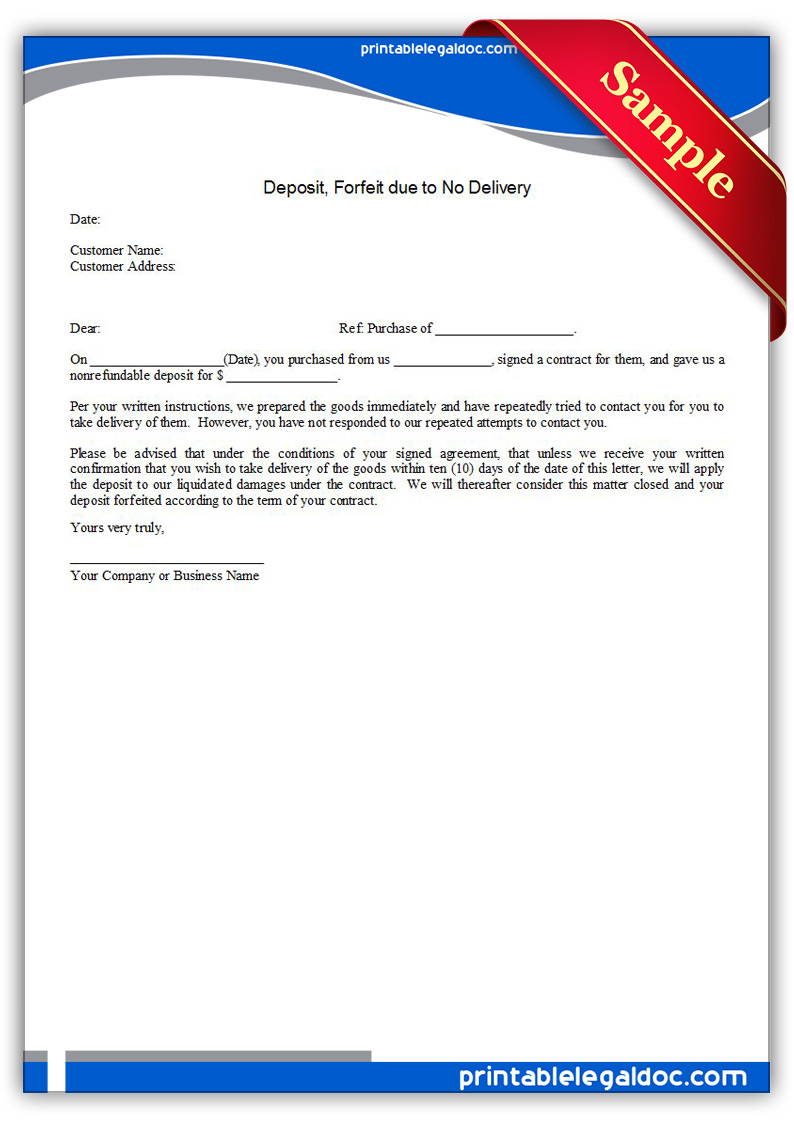
Deposit, Forfeit due to No Delivery
Date:
Customer Name:
Customer Address:
Dear: Ref: Purchase of ____________________.
On ___________________(Date), you purchased from us ______________, signed a contract for them, and gave us a nonrefundable deposit for $ ________________.
Per your written instructions, we prepared the goods immediately and have repeatedly tried to contact you for you to take delivery of them. However, you have not responded to our repeated attempts to contact you.
Please be advised that under the conditions of your signed agreement, that unless we receive your written confirmation that you wish to take delivery of the goods within ten (10) days of the date of this letter, we will apply the deposit to our liquidated damages under the contract. We will thereafter consider this matter closed and your deposit forfeited according to the term of your contract.
Yours very truly,
____________________________
Your Company or Business NameDeposit, Forfeit due to No Delivery
Review ListThis review list is provided to inform you about this document in question and assist you in its preparation. The purpose of this letter should be to get the customer to accept delivery of the product or service you offer. If you are in the habit of requesting a deposit before beginning work, you are well advised to use a contract, even a very short one, to indicate that not accepting custom goods or services in a timely manner after preparation will lead to the forfeit of the deposit as liquidated damages.
1. Be sure to sign the letter in the original and provide a clear direct phone number so they can contact you to arrange for prompt delivery.
2. If you are dealing with a corporation, you are still in the area of business commerce and have fewer challenges that can be brought against you for forfeiting their deposit.
3. If you are dealing with a consumer, each state has different consumer protection laws, which stand between you and having this forfeiture denied by a Court of competent jurisdiction. Therefore, the best outcome is to get acceptance of the goods or services by the consumer.
4. Deposits are always a tricky business because they indicate good faith on the other side and, of course, if nothing has been delivered yet, they stand on firmer ground-as is the case here.
5. In sum, this is a situation where negotiations, not the law, usually take precedence in the ultimate resolution. There are some companies that make quiet a sum of money in the forfeited deposit business (e.g., inexpensive furniture chains). However, it is a treacherous and usually short-lived business cycle for those that do this as a regular habit.
6. In sum, as Stephen Covey says in his book on habits, “Keep the end in mind.” Try to encourage the customer to take delivery of the goods or services.
Frequently Asked Questions
What is a deposit forfeiture letter for no delivery?
A deposit forfeiture letter for no delivery is a formal notice sent by a seller to a customer who has paid a nonrefundable deposit but has not taken delivery of the goods. The letter states that unless the customer provides written confirmation of their intent to take delivery within ten days, the deposit will be applied to liquidated damages and forfeited. It serves as a final attempt to resolve the matter before considering it closed.
When should a business send a deposit forfeiture letter?
A business should send this letter after the customer has signed a contract, paid a nonrefundable deposit, and failed to respond to repeated attempts to arrange delivery. The letter gives the customer a final opportunity to take delivery within a specified period, typically ten days. It is used when the seller has prepared the goods as instructed but the customer has not fulfilled their obligation to accept them.
What are liquidated damages in the context of a deposit forfeiture?
Liquidated damages are a predetermined amount of compensation specified in a contract that the seller is entitled to if the buyer breaches the agreement. In this context, the nonrefundable deposit is applied to liquidated damages when the customer fails to take delivery. This compensates the seller for losses incurred due to the breach.
How long does a customer have to respond to a deposit forfeiture letter?
The customer typically has ten (10) days from the date of the letter to provide written confirmation that they wish to take delivery of the goods. This deadline is explicitly stated in the letter. If the customer does not respond within that timeframe, the deposit will be forfeited.
What happens if the customer does not respond to the deposit forfeiture letter?
If the customer does not respond within the specified ten-day period, the seller will apply the deposit to liquidated damages under the contract. The matter will then be considered closed, and the deposit will be forfeited according to the terms of the contract. The customer will have no further claim to the deposit.
Is the deposit refundable if the customer never takes delivery?
No, the deposit is nonrefundable as stated in the contract. If the customer fails to take delivery and does not respond to the letter, the deposit is forfeited and applied to liquidated damages. The letter serves as notice of this action.
What should be included in a deposit forfeiture letter?
The letter should include the customer's name and address, the date of purchase, a description of the goods, the amount of the deposit, and a statement that the deposit is nonrefundable. It should also mention that the goods were prepared as instructed and that repeated attempts to contact the customer were made. Finally, it should specify the ten-day deadline for written confirmation and state that the deposit will be forfeited if no response is received.
Can a seller keep a deposit if the customer breaches the contract?
Yes, if the contract specifies that the deposit is nonrefundable and the customer breaches by not taking delivery, the seller may keep the deposit as liquidated damages. The letter formalizes this action by giving the customer a final chance to comply. If the customer fails to respond, the deposit is forfeited.
What is the purpose of a deposit forfeiture letter?
The purpose is to formally notify the customer that their deposit is at risk of forfeiture due to non-delivery and to prompt them to take action. It also serves as a record of the seller's attempts to resolve the issue and their intention to claim liquidated damages. This letter helps the seller close the matter in accordance with the contract terms.
How should a business handle a customer who refuses to take delivery?
The business should first attempt to contact the customer multiple times to arrange delivery. If those attempts fail, the business should send a deposit forfeiture letter giving the customer a final deadline to respond. If the customer still does not respond, the business may apply the deposit to liquidated damages and consider the matter closed, as per the contract.




oh my god, I love you, this is amazing, and just what I needed! , they’re awesome
Thanks! Awesome work you did here.Im glad i found your site.
Wonderful blank template you have here.
great set of printable forms around your site.
Beautiful work and nicely accomplished!
Beautiful work, I love every bit of it! Your hard work really paid off; it turned out perfectly.
Beautiful work and nicely accomplished!
wow!! so huge collection of form. My student will need this in their future career.
This one is beautiful! Thank you for this form.
i want this Printable Form!!!!!