
This review list is intended to educate you on the subject of this document and to facilitate you in its preparation. Similar to the pledge of stock assets, the pledge of life insurance proceeds is similar. Advice and guidance on this matter can be found in the notes to the Pledge of Stock form. This advice is offered to ensure that you understand that there are no fundamental differences in the effect of these pledges except that an insurance pledge cannot be “sold” like a stock asset.
1. Make several copies. Ascertain that each relevant person receives a copy

Pledge Of Life Insurance
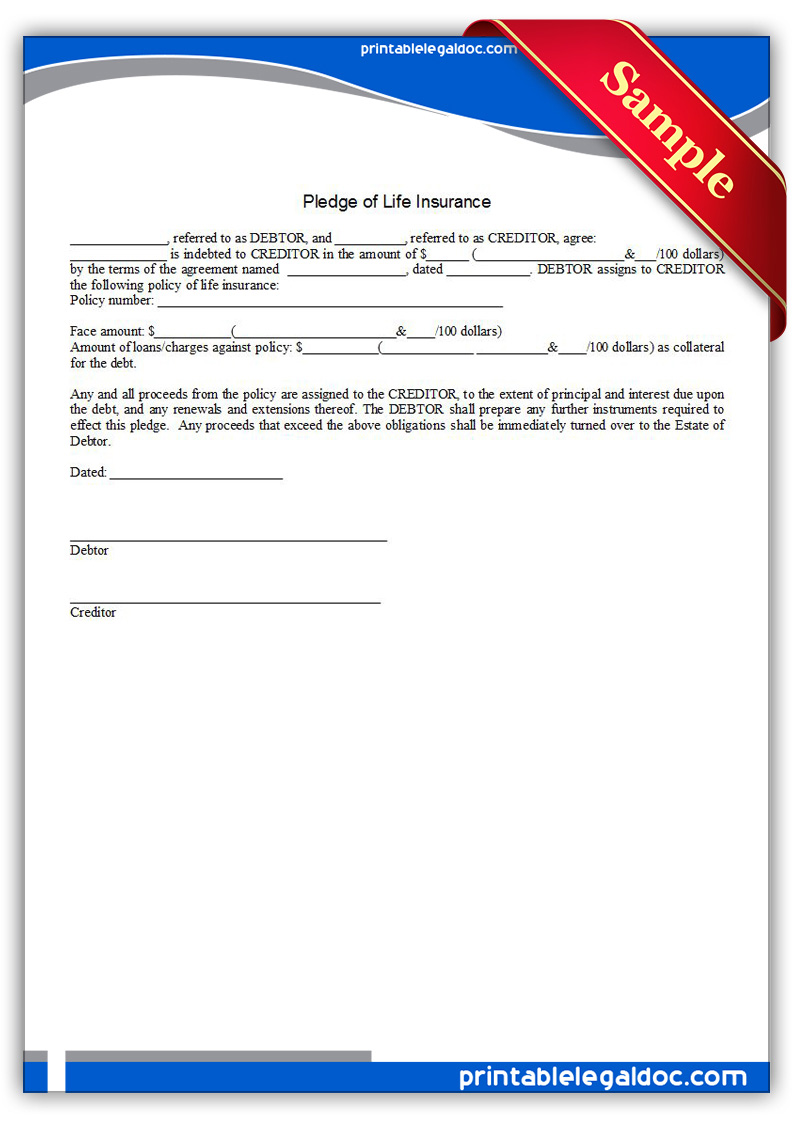
Pledge of Life Insurance
______________, referred to as DEBTOR, and __________, referred to as CREDITOR, agree:
______________ is indebted to CREDITOR in the amount of $______ (_____________________&___/100 dollars) by the terms of the agreement named _________________, dated ____________. DEBTOR assigns to CREDITOR the following policy of life insurance:
Policy number: __________________________________________________Face amount: $___________(_______________________&____/100 dollars)
Amount of loans/charges against policy: $___________(_____________ __________&____/100 dollars) as collateral for the debt.Any and all proceeds from the policy are assigned to the CREDITOR, to the extent of principal and interest due upon the debt, and any renewals and extensions thereof. The DEBTOR shall prepare any further instruments required to effect this pledge. Any proceeds that exceed the above obligations shall be immediately turned over to the Estate of Debtor.
Dated: _________________________
______________________________________________
Debtor
_____________________________________________
CreditorPledge of Life Insurance
Review ListThis review list is provided to inform you about this document in question and assist you in its preparation. The Pledge of Life Insurance proceeds is similar to that for the Pledge of Stock assets. See the notes under the Pledge of Stock document for advice and counsel on this subject. This suggestion is made to be sure you understand there are no material differences between the effect of these pledges other than you can not “sell” an insurance pledge as you can a stock asset.
1. Make multiple copies. Be sure each relevant party has a copy.
Frequently Asked Questions
What is a pledge of life insurance?
A pledge of life insurance is a legal arrangement where a debtor assigns a life insurance policy to a creditor as collateral for a debt. The assignment gives the creditor rights to the policy proceeds to the extent of the debt. This is documented in a pledge agreement signed by both parties.
How does a life insurance pledge work?
In a life insurance pledge, the debtor assigns the policy to the creditor as collateral for a debt. The creditor is entitled to receive proceeds from the policy up to the amount of principal and interest due. Any excess proceeds are turned over to the debtor's estate.
What happens to the life insurance proceeds when a policy is pledged?
When a life insurance policy is pledged, the proceeds are assigned to the creditor to the extent of the debt, including principal and interest. Any remaining proceeds that exceed the debt obligations are immediately turned over to the estate of the debtor. This ensures the creditor is repaid while any surplus goes to the debtor's beneficiaries.
Who receives the excess proceeds from a pledged life insurance policy?
Any proceeds from the pledged life insurance policy that exceed the debt obligations are immediately turned over to the Estate of the Debtor. This means that after the creditor is repaid, the remaining funds go to the debtor's estate. The pledge agreement specifies this distribution.
What information is needed to pledge a life insurance policy?
To pledge a life insurance policy, you need details such as the policy number, face amount, and any loans or charges against the policy. The agreement also requires the debt amount, the names of the debtor and creditor, and the date of the original agreement. This information is included in the pledge document.
Is a pledge of life insurance the same as assigning a policy?
Yes, a pledge of life insurance involves assigning the policy to the creditor as collateral for a debt. The terms 'pledge' and 'assignment' are used interchangeably in this context. The assignment is limited to the extent of the debt, with excess proceeds going to the debtor's estate.
What are the obligations of the debtor in a life insurance pledge?
The debtor is obligated to prepare any further instruments required to effect the pledge. This ensures the creditor's rights are properly documented and enforceable. The debtor must also ensure the policy remains in force and that any proceeds are directed as specified.
Can a life insurance policy with loans be pledged?
Yes, a life insurance policy with existing loans or charges can be pledged. The pledge agreement includes the amount of loans or charges against the policy. The creditor's claim is limited to the debt amount, and any excess proceeds after repaying the debt go to the debtor's estate.
What happens if the debt is repaid before the life insurance policy matures?
The pledge agreement does not specify what happens if the debt is repaid early. However, once the debt is satisfied, the creditor's claim on the policy proceeds ends. The debtor may then need to take steps to release the pledge, though the document does not detail this process.
What is the purpose of a pledge of life insurance?
The purpose of a pledge of life insurance is to provide collateral for a debt using a life insurance policy. This gives the creditor security in case the debtor defaults. The creditor can recover the debt from the policy proceeds, while any excess goes to the debtor's estate.


