
Power of Attorney and Declaration of Representative
Taxpayer(s) name, identifying number, and address including ZIP code:
____________________________
____________________________
____________________________
____________________________hereby appoints (names(s), CAF number(s), address (es), including ZIP code(s), and telephone numbers:
____________________________
____________________________
____________________________
____________________________
____________________________as attorney(s)-in-fact to represent the taxpayer(s) before any office of the Internal Revenue Service for the following tax matter(s) (specify the type(s) of tax and year(s) or period(s) (date of death if estate tax):
Type of tax: _________________
Federal tax number: __________
Year(s) or period(s) _________
Date of death if estate tax: _____The attorney(s)-in-fact (or either of them) are authorized, subject to revocation, to receive confidential information and to perform and any all acts that the principal(s) can perform with respect to the above specified tax matters (excluding the power to receive refund checks, and the power to sign the return (see regulations section 1.6012-1(a)(5), Returns made by agents), unless specifically granted below.)
Send copies of notice and other written communications addressed to the taxpayer(s) in proceedings involving the tax matters to:
the appointee first named aboveTaxpayer initial here: _________________ if you are granting the power to receive, but not to endorse or cash, refund checks for the above tax matters to:
the appointee first named aboveThis power of attorney revokes all earlier powers of attorney and tax information authorizations on file with the Internal Revenue Service for the same tax matters and years or periods covered by this power of attorney, except the following:
__________________________________________________________________Signature of or for taxpayer(s):
(If signed by a corporate officer, partner, or fiduciary on behalf of the taxpayer, I certify that I have the authority to execute this power of attorney on behalf of the taxpayer.)________________________________________________
Signature
________________________________________________
TitleDate: ___________________________
If the power of attorney is granted to a person other than an attorney, certified public accountant, enrolled agent, or enrolled actuary, the taxpayer(s) signature must be witnesses or notarized below. (The representative must complete Part II. Only representative listed there are recognized to practice before the Internal Revenue Service.
The persons signing as or for the taxpayer(s) (Check and complete one):
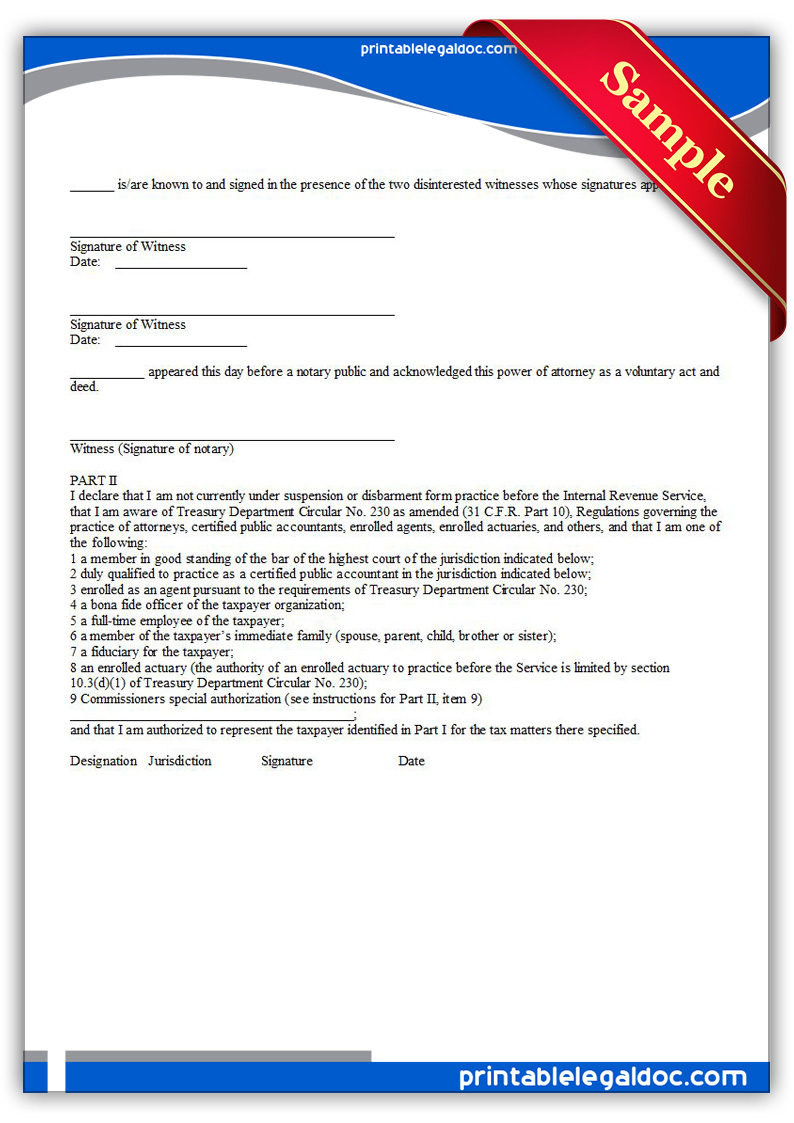
______ is/are known to and signed in the presence of the two disinterested witnesses whose signatures appear here:
_______________________________________________
Signature of Witness
Date: ___________________
_______________________________________________
Signature of Witness
Date: _____________________________ appeared this day before a notary public and acknowledged this power of attorney as a voluntary act and deed.
_______________________________________________
Witness (Signature of notary)PART II
I declare that I am not currently under suspension or disbarment form practice before the Internal Revenue Service, that I am aware of Treasury Department Circular No. 230 as amended (31 C.F.R. Part 10), Regulations governing the practice of attorneys, certified public accountants, enrolled agents, enrolled actuaries, and others, and that I am one of the following:
1 a member in good standing of the bar of the highest court of the jurisdiction indicated below;
2 duly qualified to practice as a certified public accountant in the jurisdiction indicated below;
3 enrolled as an agent pursuant to the requirements of Treasury Department Circular No. 230;
4 a bona fide officer of the taxpayer organization;
5 a full-time employee of the taxpayer;
6 a member of the taxpayer’s immediate family (spouse, parent, child, brother or sister);
7 a fiduciary for the taxpayer;
8 an enrolled actuary (the authority of an enrolled actuary to practice before the Service is limited by section 10.3(d)(1) of Treasury Department Circular No. 230);
9 Commissioners special authorization (see instructions for Part II, item 9) _________________________________________;
and that I am authorized to represent the taxpayer identified in Part I for the tax matters there specified.Designation Jurisdiction Signature Date
Power of Attorney and Declaration of Representative
Review ListThis review list is provided to inform you about this document in question and assist you in its preparation. This document is required for the Internal Revenue Service, should you want someone properly qualified to represent you at any meetings with them. A qualified representative will furnish you with the latest IRS document. This is representative of the information that must be provided.
Frequently Asked Questions
What is a Power of Attorney and Declaration of Representative form?
A Power of Attorney and Declaration of Representative is a document that allows a taxpayer to appoint an attorney-in-fact to represent them before the Internal Revenue Service. The form specifies the taxpayer's name, identifying number, and address, as well as the representative's details. It grants the representative authority to receive confidential information and perform acts on behalf of the taxpayer for specified tax matters.
Who can be appointed as an attorney-in-fact on this form?
The form allows the taxpayer to appoint one or more individuals as attorney(s)-in-fact. The names, CAF numbers, addresses, and telephone numbers of the appointed representatives must be provided. The form does not restrict who can be appointed, but typically they are tax professionals such as CPAs, enrolled agents, or attorneys.
What tax matters can a representative handle under this power of attorney?
The representative is authorized to act on behalf of the taxpayer for the tax matters specified in the form. These matters include the type of tax and the year(s) or period(s) involved. For estate tax, the date of death must also be specified.
What powers does the attorney-in-fact have?
The attorney-in-fact is authorized to receive confidential information and to perform any and all acts that the principal can perform with respect to the specified tax matters. However, this authority is subject to revocation. The power does not include the ability to receive refund checks or to sign the return, as noted in the form.
Can the power of attorney be revoked?
Yes, the authority granted to the attorney-in-fact is subject to revocation. The form explicitly states that the authorization is subject to revocation. This means the taxpayer can revoke the power of attorney at any time.
What information is required to complete the Power of Attorney form?
The form requires the taxpayer's name, identifying number, and address including ZIP code. It also requires the name(s), CAF number(s), address(es), including ZIP code(s), and telephone number(s) of the attorney(s)-in-fact. Additionally, the type of tax, federal tax number, and year(s) or period(s) must be specified.
What is a CAF number?
The form requires the CAF number(s) of the attorney(s)-in-fact. CAF stands for Centralized Authorization File, which is a system used by the IRS to track authorizations. The form does not provide further details about CAF numbers.
Can the attorney-in-fact sign the tax return?
No, the power of attorney form explicitly excludes the power to sign the return. The form references regulations section 1.6012-1(a)(5) regarding returns made by agents. Therefore, the attorney-in-fact cannot sign the return on behalf of the taxpayer.
Can the attorney-in-fact receive refund checks?
No, the form excludes the power to receive refund checks. The authorization granted to the attorney-in-fact does not include this power. Therefore, the representative cannot receive refund checks on behalf of the taxpayer.
What is the purpose of specifying the type of tax and year(s) or period(s) on the form?
Specifying the type of tax and year(s) or period(s) defines the scope of the tax matters for which the representative is authorized to act. This ensures that the power of attorney is limited to those specific matters. For estate tax, the date of death must also be provided.