

Charitable Remainder to a Trust
A Trust is a legal document containing a formal agreement between parties in which one party grants or vests the ownership rights (title) to one or more trustees for the purposes of conservation, protection, or preservation on behalf of the first party or beneficiary of the trust. This instrument normally and usually states: The reasons and purposes as to why the trust was established and the actions that will terminate the trust, a detailed record of what assets are placed and present in the trust, the authority and boundaries of the said trustees, the reporting requirements of the trustees, and other provisions associated to the trust. It may also state the compensation that the trustees will be receiving, if there are any.
A Charitable Remainder to a Trust or CRT is an irrevocable trust which is able to generate a potential income stream for you, as the donor, or other beneficiaries, with the remainder of the assets going to your favorite charities. In simpler terms, It is a legal document which helps you make money and at the same time, helps you pay for living expenses. There are two types of charitable remainder trusts. First is the Charitable remainder annuity trusts or CRATs which distribute a fixed amount each year and state that no additional contributions are allowed. The second is the Charitable remainder unitrusts or CRUTs which distribute a fixed percentage and state that additional contributions are allowed. A charitable remainder trust works in this way: It makes a partially tax-deductible donation, You and other associated trustees receive an income stream, and after the death of the last incom trustee, the remaining CRT assets are strewn about the said charities.
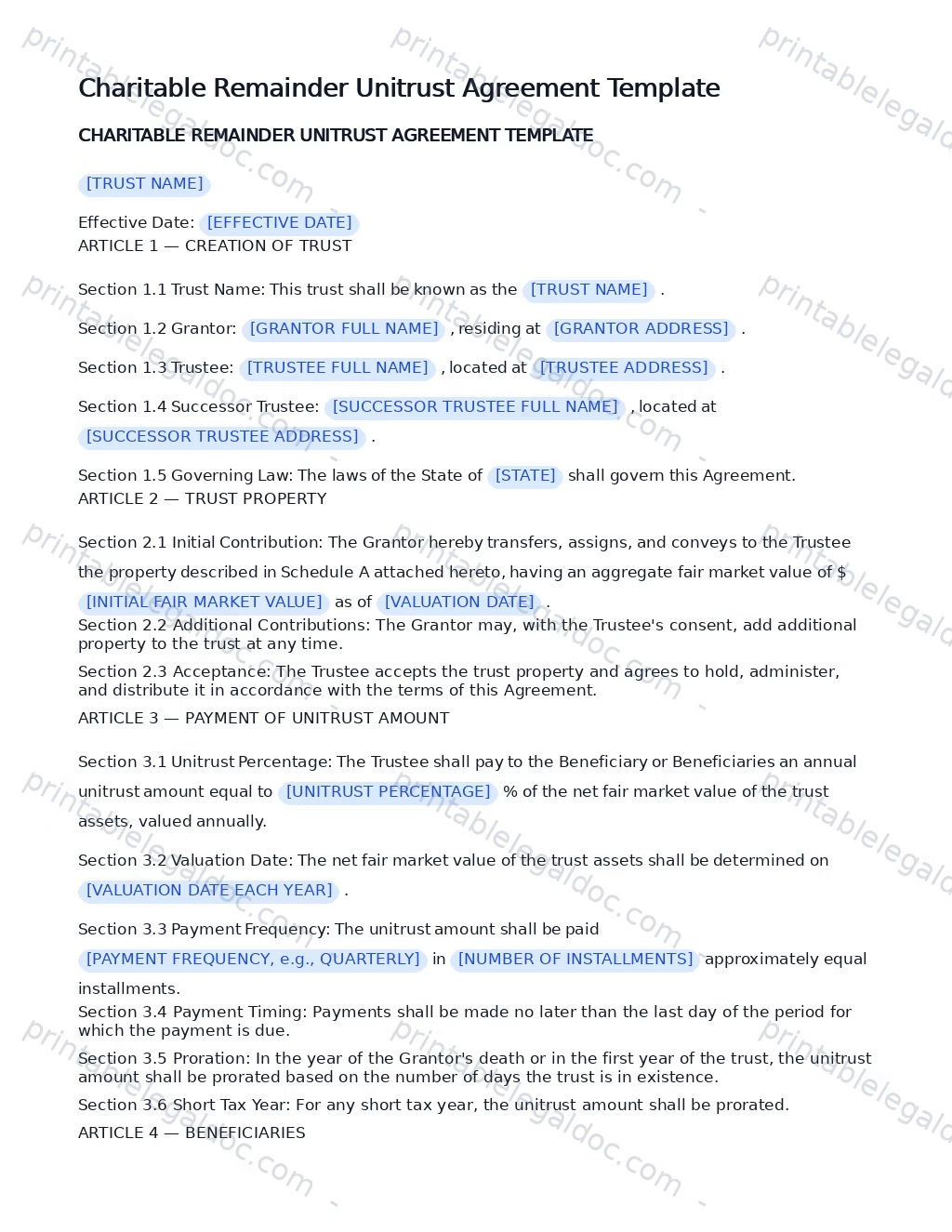
Charitable Remainder Unitrust Agreement Template
A Charitable Remainder Unitrust Agreement Template gives you a ready structure for planned giving. It outlines how a donor transfers assets into a trust. The trust then pays income to beneficiaries for life or a set term. What remains goes to charity. Our template covers key sections like trustee duties, payout percentages, and asset management. It saves you time drafting from scratch. You get clear language that follows common legal standards. Review it with an attorney before use. This tool suits nonprofits, donors, and advisors who want a solid starting point. It helps you move faster on charitable planning. Grab the template and simplify your next unitrust setup.

Charitable Remainder Annuity Trust Template
A charitable remainder annuity trust template gives you a ready framework for planned giving. It sets fixed annual payments to you or your chosen beneficiary. The remaining assets then pass to your favorite charity. Our template covers the key sections. You get trust terms, payment schedules and beneficiary details in one document. Each part is easy to edit and adapt to your situation. Clear language keeps the setup simple for donors and advisors alike. Use it to save time on drafting and reduce costly mistakes. Start with a solid structure and focus on your giving goals instead of paperwork.
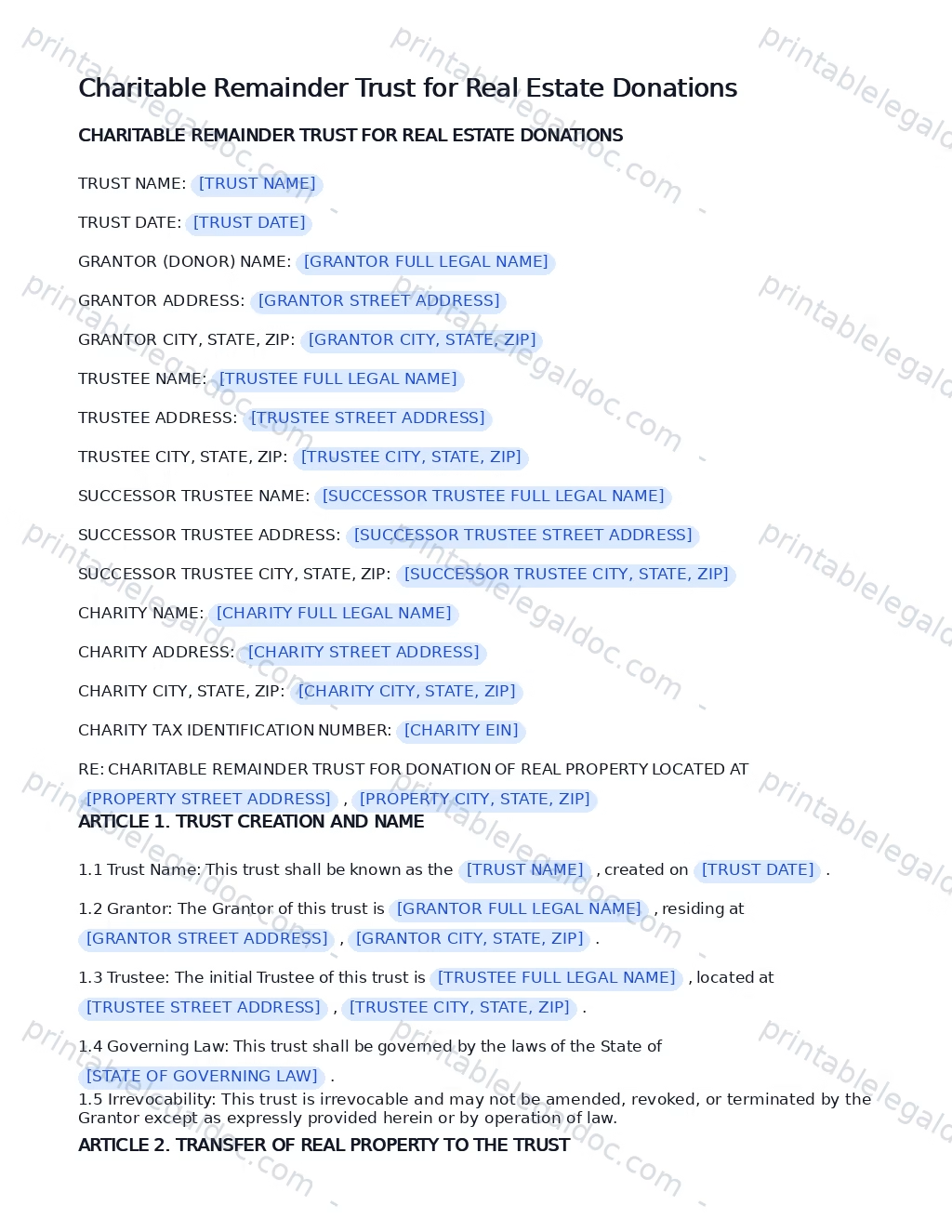
Charitable Remainder Trust for Real Estate Donations
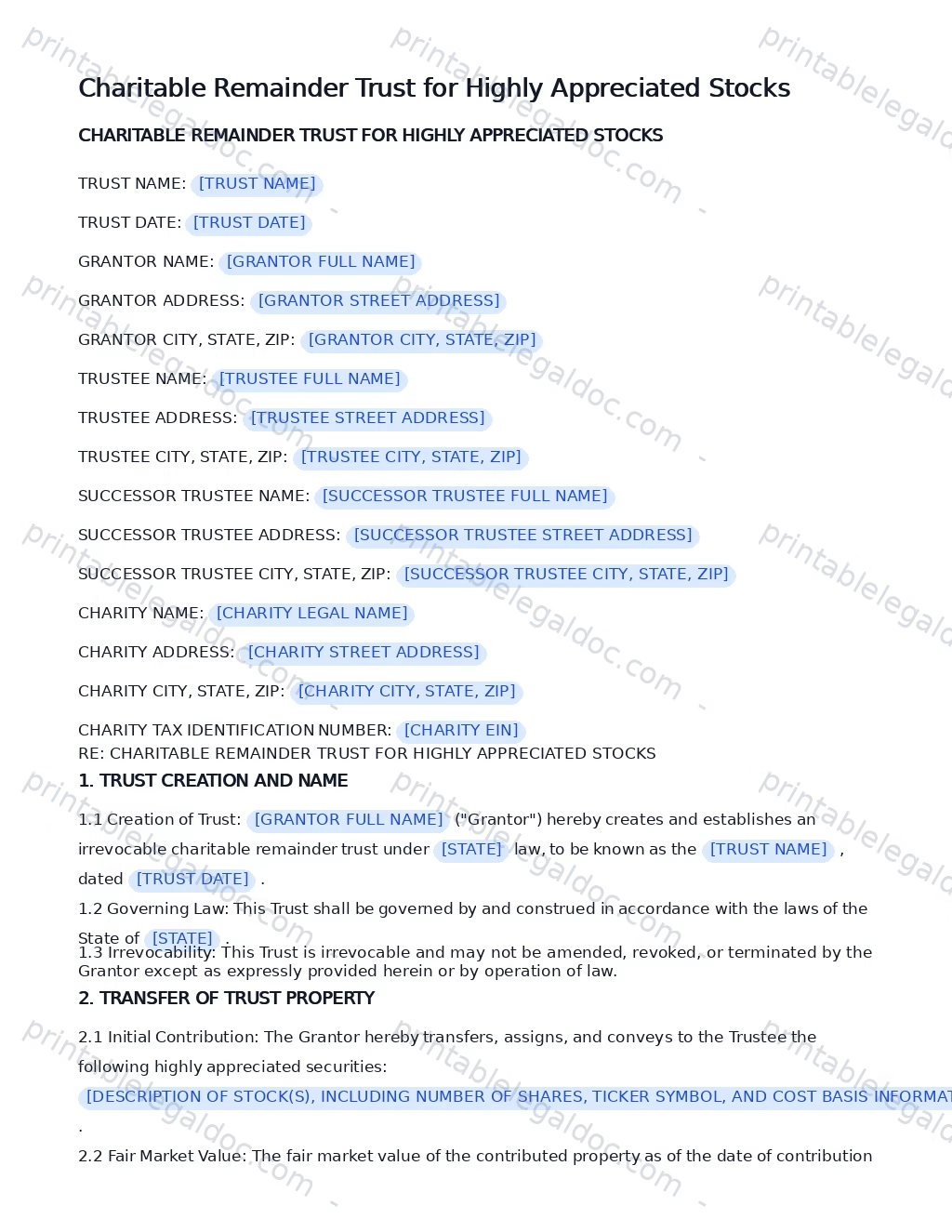
Charitable Remainder Trust for Highly Appreciated Stocks
A charitable remainder trust can turn highly appreciated stocks into steady income for you and a lasting gift for charity. You transfer shares into the trust. The trust sells them without immediate capital gains tax. Then it pays you income for life or a set term. Whatever remains goes to the charity you choose. This strategy suits donors who hold low basis stock and want to reduce tax exposure. It also offers a way to support a cause you care about. Talk with a tax advisor first. Your situation is unique.
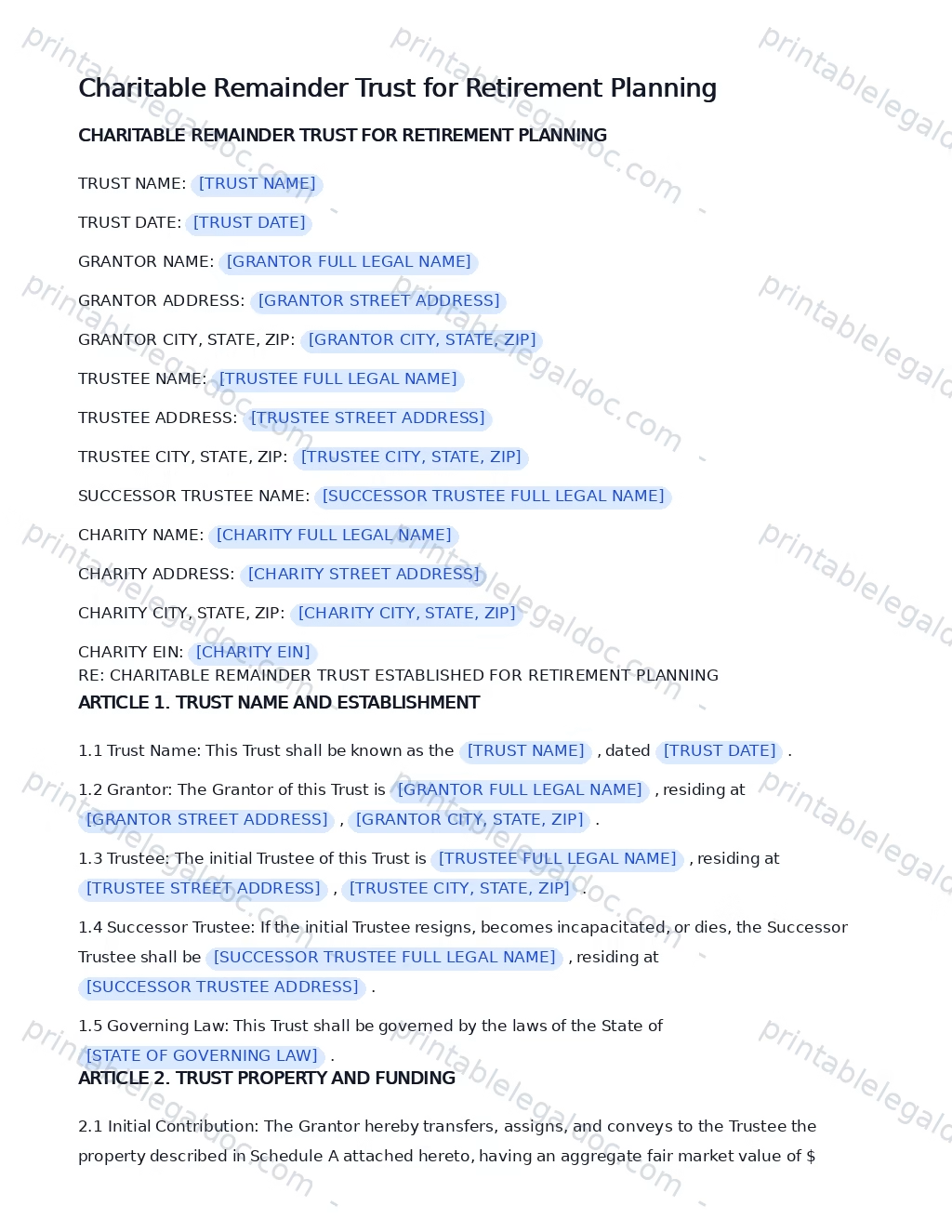
Charitable Remainder Trust for Retirement Planning
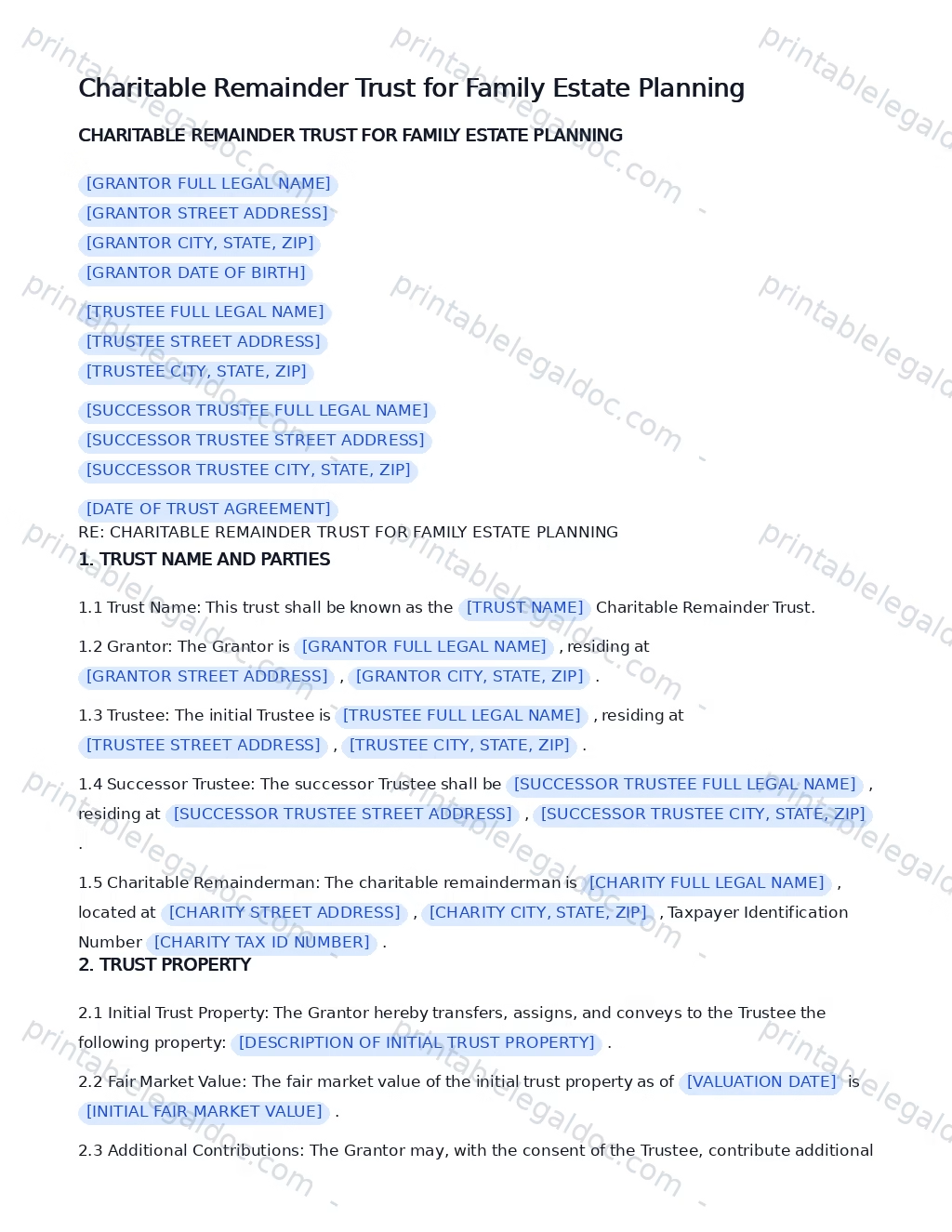
Charitable Remainder Trust for Family Estate Planning
A Charitable Remainder Trust can help you support family and charity at the same time. You place assets into the trust. The trust pays income to your beneficiaries for a set term. After that, the remaining amount goes to a charity you choose. This strategy may reduce estate taxes and create a steady income stream. It also lets you leave a lasting legacy. Families often use this tool to balance generosity with financial security. Talk with an estate planning attorney to see if this trust fits your goals.

Charitable Remainder Trust for Business Owners
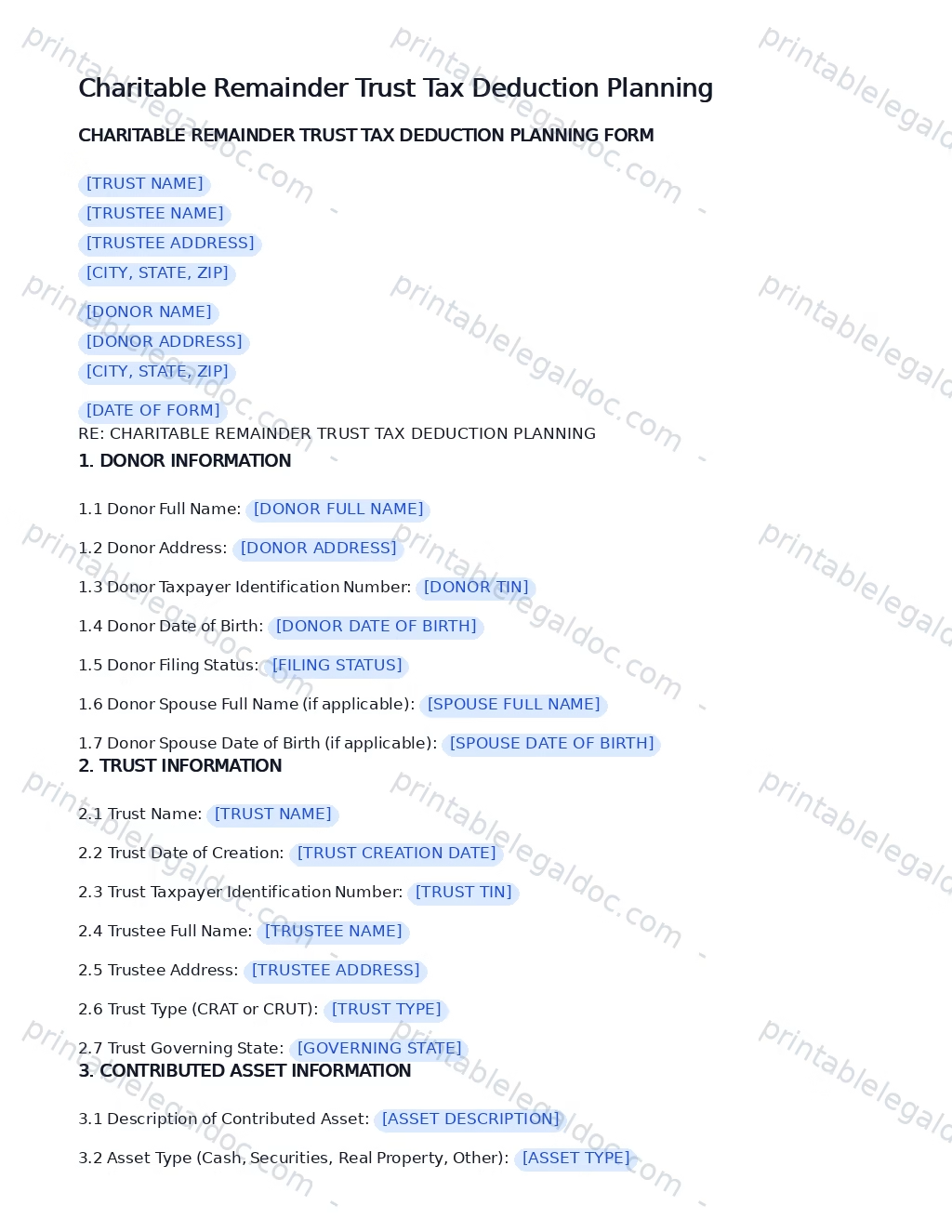
Charitable Remainder Trust Tax Deduction Planning
A charitable remainder trust can turn a highly appreciated asset into income for you and a gift for charity. You transfer the asset into the trust. The trust pays you or your chosen beneficiaries an income stream for life or a set term. When the term ends, the remaining assets go to the charity you select. You often receive an immediate income tax deduction for the present value of the future charitable gift. That deduction can offset taxes in the year of the transfer. The trust may also sell the asset without immediate capital gains tax. This gives the trustee more to invest for your income. Careful planning matters here. Work with a tax advisor to model the deduction and review the rules. Then confirm the numbers fit your goals.
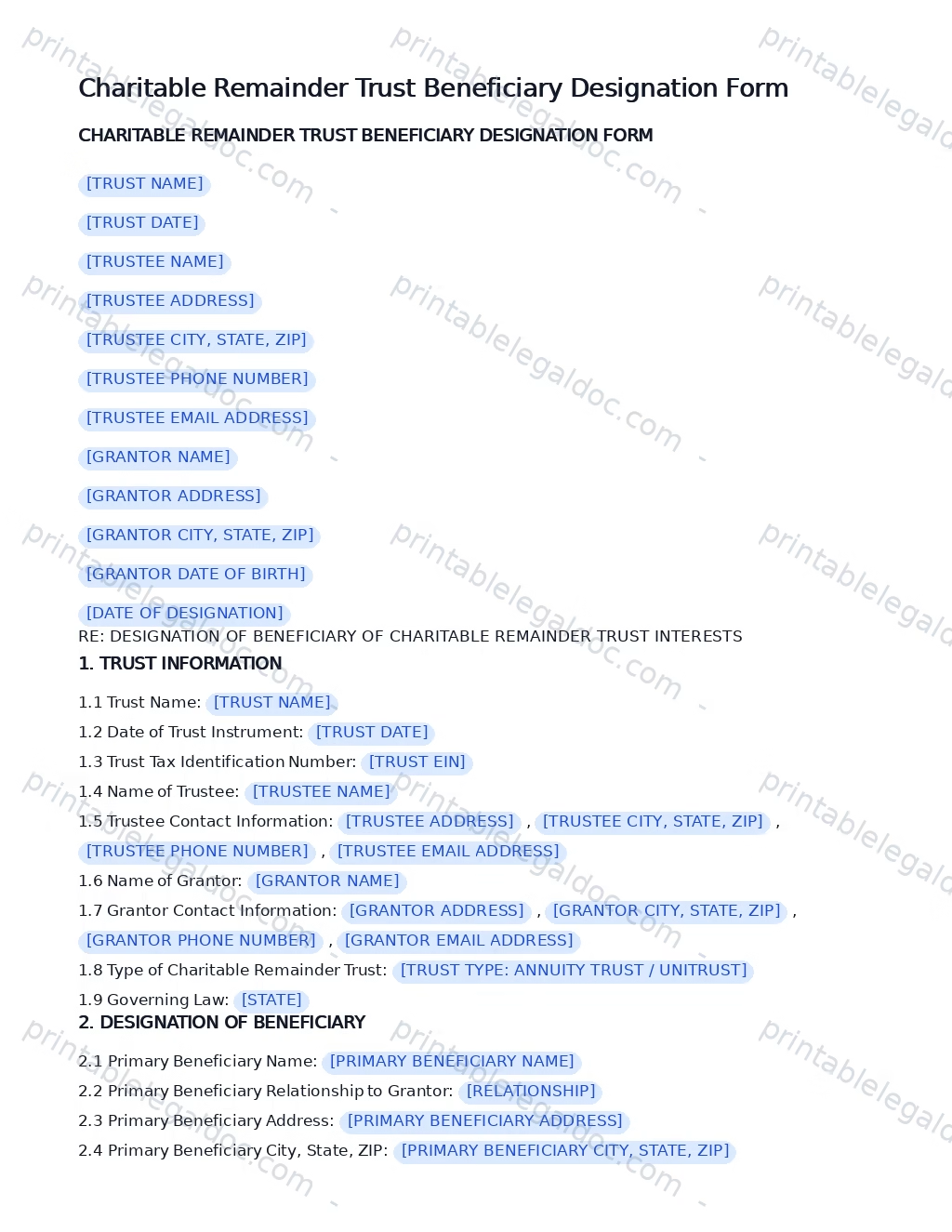
Charitable Remainder Trust Beneficiary Designation Form
A Charitable Remainder Trust Beneficiary Designation Form lets you name who receives trust income and who gets the remainder. Fill it out with clear intent. List each beneficiary by full legal name. State the percentage or share each person receives. Include contingent beneficiaries in case a primary one cannot serve. Review payout terms and charity details before signing. Date the form and keep copies with your estate documents. This simple record prevents confusion later. It also protects your wishes. Update the form after major life events. A well completed designation keeps your gift plan on track.
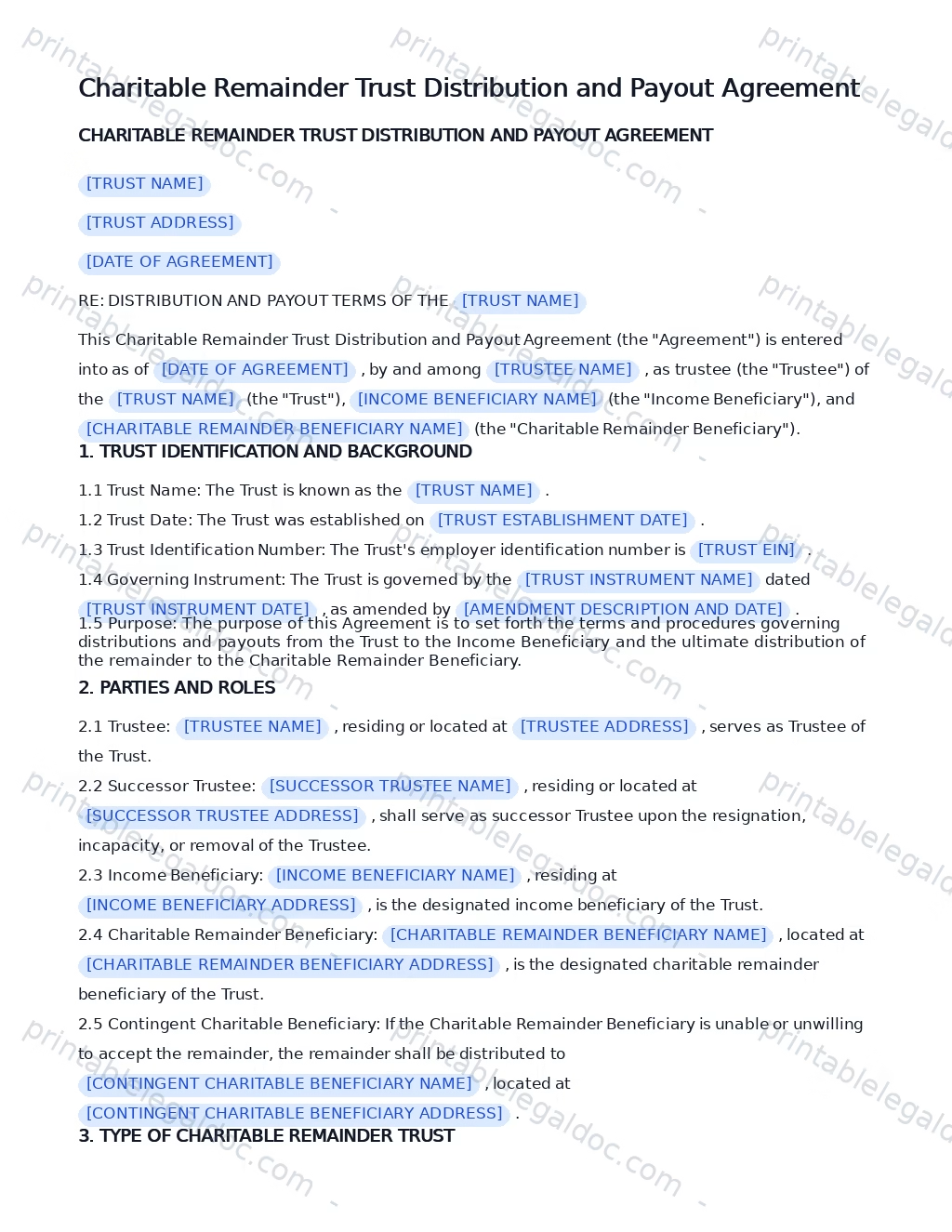
Charitable Remainder Trust Distribution and Payout Agreement
A Charitable Remainder Trust Distribution and Payout Agreement sets the rules for how trust income reaches beneficiaries. This document spells out payment amounts. It also defines timing and duration. You get clear terms for annuity or unitrust distributions. The agreement protects both the donor and the charity. It shows how assets flow each year. Trustees rely on it to stay compliant. Beneficiaries gain certainty about their share. The charity knows what remains for its future use. Every detail stays in writing. That reduces disputes later. Use this template to formalize your payout structure. It covers fixed percentages and variable methods. Customize the fields to match your trust terms. Then sign and keep a copy on file.
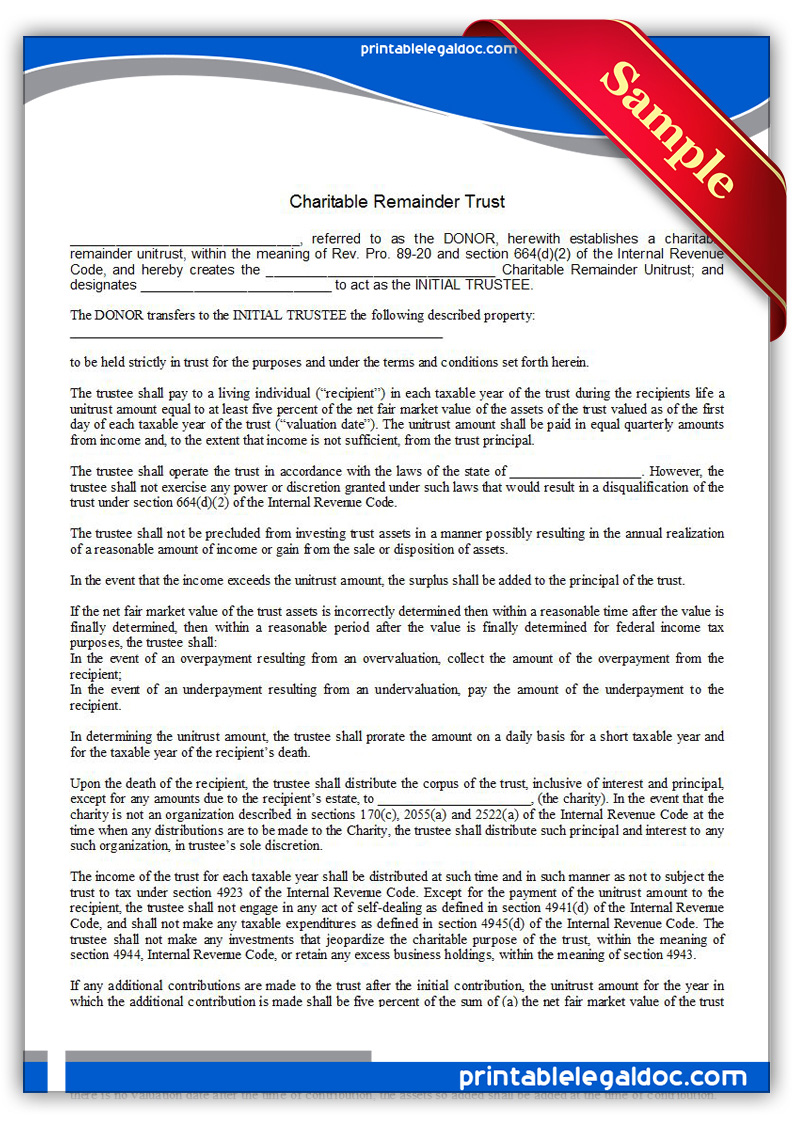
Charitable Remainder Trust
______________________________, referred to as the DONOR, herewith establishes a charitable remainder unitrust, within the meaning of Rev. Pro. 89-20 and section 664(d)(2) of the Internal Revenue Code, and hereby creates the ______________________________ Charitable Remainder Unitrust; and designates _________________________ to act as the INITIAL TRUSTEE.
The DONOR transfers to the INITIAL TRUSTEE the following described property:
______________________________________________________to be held strictly in trust for the purposes and under the terms and conditions set forth herein.
The trustee shall pay to a living individual (“recipient”) in each taxable year of the trust during the recipients life a unitrust amount equal to at least five percent of the net fair market value of the assets of the trust valued as of the first day of each taxable year of the trust (“valuation date”). The unitrust amount shall be paid in equal quarterly amounts from income and, to the extent that income is not sufficient, from the trust principal.
The trustee shall operate the trust in accordance with the laws of the state of ___________________. However, the trustee shall not exercise any power or discretion granted under such laws that would result in a disqualification of the trust under section 664(d)(2) of the Internal Revenue Code.
The trustee shall not be precluded from investing trust assets in a manner possibly resulting in the annual realization of a reasonable amount of income or gain from the sale or disposition of assets.
In the event that the income exceeds the unitrust amount, the surplus shall be added to the principal of the trust.
If the net fair market value of the trust assets is incorrectly determined then within a reasonable time after the value is finally determined, then within a reasonable period after the value is finally determined for federal income tax purposes, the trustee shall:
In the event of an overpayment resulting from an overvaluation, collect the amount of the overpayment from the recipient;
In the event of an underpayment resulting from an undervaluation, pay the amount of the underpayment to the recipient.In determining the unitrust amount, the trustee shall prorate the amount on a daily basis for a short taxable year and for the taxable year of the recipient’s death.
Upon the death of the recipient, the trustee shall distribute the corpus of the trust, inclusive of interest and principal, except for any amounts due to the recipient’s estate, to ______________________, (the charity). In the event that the charity is not an organization described in sections 170(c), 2055(a) and 2522(a) of the Internal Revenue Code at the time when any distributions are to be made to the Charity, the trustee shall distribute such principal and interest to any such organization, in trustee’s sole discretion.
The income of the trust for each taxable year shall be distributed at such time and in such manner as not to subject the trust to tax under section 4923 of the Internal Revenue Code. Except for the payment of the unitrust amount to the recipient, the trustee shall not engage in any act of self-dealing as defined in section 4941(d) of the Internal Revenue Code, and shall not make any taxable expenditures as defined in section 4945(d) of the Internal Revenue Code. The trustee shall not make any investments that jeopardize the charitable purpose of the trust, within the meaning of section 4944, Internal Revenue Code, or retain any excess business holdings, within the meaning of section 4943.
If any additional contributions are made to the trust after the initial contribution, the unitrust amount for the year in which the additional contribution is made shall be five percent of the sum of (a) the net fair market value of the trust assets as of the first day of the taxable years (excluding the assets so added and any income form, or appreciation and gain on such assets) and (b) the proportion of the value of the assets so added that was excluded under (a) that the number of days in the period that begins with the date of contribution and ends with the earlier of the last day of the taxable year or the recipient’s death bears to the number of days in the period that begins on the first day of such taxable year and ends with the earlier of the last day in such taxable year or the recipient’s death. In the case where there is no valuation date after the time of contribution, the assets so added shall be added at the time of contribution.
The donor reserves the right to dismiss the trustee and to appoint a successor.
The trust is irrevocable, however, the trustee shall have the power, acting alone, to amend the trust in any manner which is required for the sole purpose of continuation of the trust’s qualification as a charitable remainder unitrust within the meaning of section 664(d)(2) of the Internal Revenue Code.
Dated: ________________
__________________________________
DONOR__________________________________
TRUSTEEThe TRUSTEE herewith acknowledges receipt of the trust assets described above.
Dated: ________________
__________________________________
TRUSTEE
Charitable Remainder Trust
Review ListThis review list is provided to inform you about this document in question and assist you in its preparation. This is a standard charitable remainder trust. You should add or delete items as appropriate.
1. Make multiple copies. Give one to each signatory. Keep one in your home safe. Keep one in the related transaction file.
Frequently Asked Questions
What is a charitable remainder unitrust?
A charitable remainder unitrust is a type of charitable remainder trust established under section 664(d)(2) of the Internal Revenue Code and Revenue Procedure 89-20. The donor transfers property to a trustee, who pays a unitrust amount to one or more recipients for life or a term of years, after which the remaining assets pass to charity. The trust must be operated in accordance with the laws of the state specified in the trust document.
How is the unitrust amount calculated?
The unitrust amount is equal to at least five percent of the net fair market value of the trust assets, valued as of the first day of each taxable year of the trust. This valuation date determines the amount that must be paid for that year. The unitrust amount is recalculated annually based on the trust's assets on the valuation date.
How often are payments made from a charitable remainder unitrust?
The unitrust amount is paid in equal quarterly amounts. Payments are made from trust income and, to the extent that income is not sufficient, from trust principal. This ensures that the recipient receives the required distribution even if the trust's income is lower than the unitrust amount.
Who can be a recipient of a charitable remainder unitrust?
The trustee pays the unitrust amount to a living individual referred to as the recipient. The trust document specifies the recipient, and payments are made during the recipient's life. The trust may have one or more recipients as provided in the terms of the trust.
What happens to the remaining assets in a charitable remainder unitrust?
After the termination of the trust, the remaining assets pass to the charitable remainder beneficiary designated in the trust. The trust must be operated strictly in accordance with its terms, which include the charitable purpose. The donor does not retain control over the remainder interest.
What property can be transferred to a charitable remainder unitrust?
The donor transfers property to the initial trustee as described in the trust document. The property is held strictly in trust for the purposes and under the terms and conditions set forth in the trust. The trust can hold various types of assets, but the specific property must be identified in the trust instrument.
Who acts as the trustee of a charitable remainder unitrust?
The trust designates an initial trustee to act as the trustee. The trustee is responsible for managing the trust assets and making the required unitrust payments. The trustee must operate the trust in accordance with the laws of the state specified in the trust document.
What tax rules apply to a charitable remainder unitrust?
The trust is established within the meaning of Revenue Procedure 89-20 and section 664(d)(2) of the Internal Revenue Code. These provisions govern the requirements for the trust to qualify as a charitable remainder unitrust. The trust must comply with these rules to receive favorable tax treatment.
Can the trustee use trust principal to make payments?
Yes, the unitrust amount is paid from income and, to the extent that income is not sufficient, from the trust principal. This ensures that the recipient receives the full unitrust amount each year. The trustee must make these payments in equal quarterly installments.
What state law governs a charitable remainder unitrust?
The trustee must operate the trust in accordance with the laws of the state specified in the trust document. The trust document includes a blank for the state whose laws will govern the trust. This choice of law provision determines the legal rules that apply to the trust's administration.


