


This review list is intended to educate you about the content of this document and to aid you in its preparation. This is a typical statement for a nominee trust. You are welcome to tweak it to match your own conditions.
- Make several copies. A copy of the trust agreements should be kept to be filed with the
registration of deeds as and when necessary. Another copy should be kept with the transaction file.
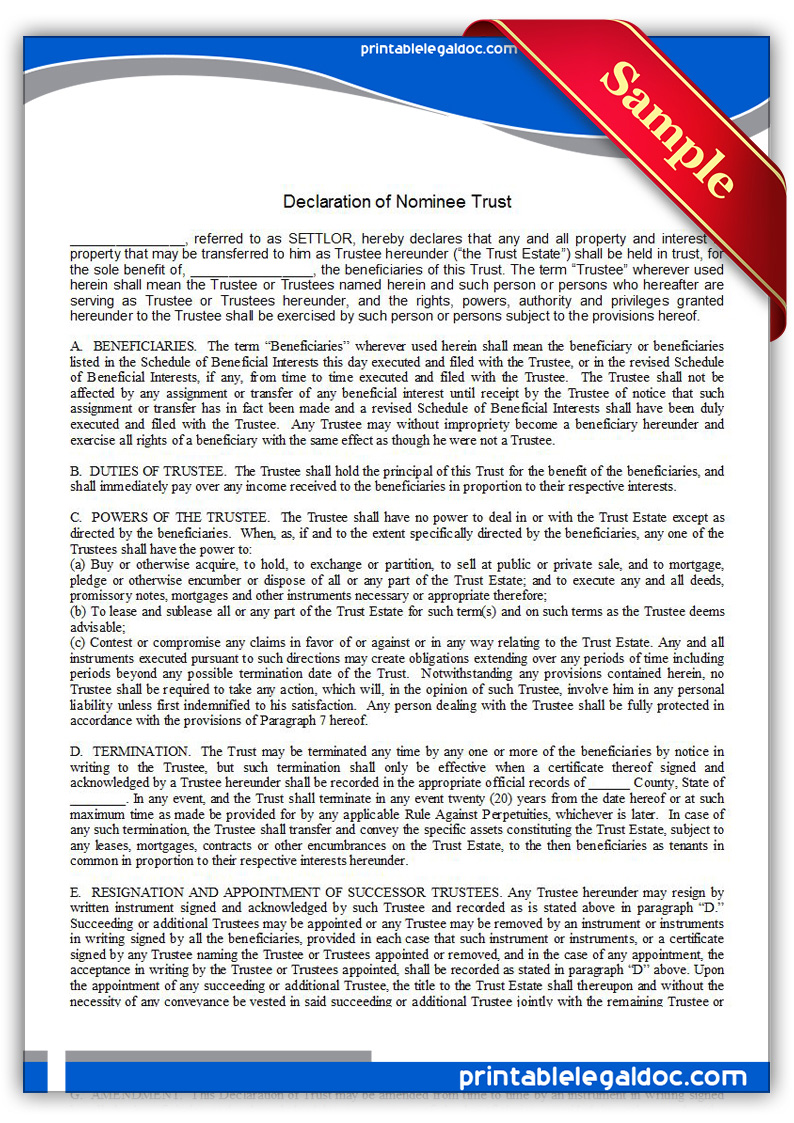
Declaration Of Nominee Trust
Declaration of Nominee Trust
_______________, referred to as SETTLOR, hereby declares that any and all property and interest in property that may be transferred to him as Trustee hereunder (“the Trust Estate”) shall be held in trust, for the sole benefit of, ________________, the beneficiaries of this Trust. The term “Trustee” wherever used herein shall mean the Trustee or Trustees named herein and such person or persons who hereafter are serving as Trustee or Trustees hereunder, and the rights, powers, authority and privileges granted hereunder to the Trustee shall be exercised by such person or persons subject to the provisions hereof.
A. BENEFICIARIES. The term “Beneficiaries” wherever used herein shall mean the beneficiary or beneficiaries listed in the Schedule of Beneficial Interests this day executed and filed with the Trustee, or in the revised Schedule of Beneficial Interests, if any, from time to time executed and filed with the Trustee. The Trustee shall not be affected by any assignment or transfer of any beneficial interest until receipt by the Trustee of notice that such assignment or transfer has in fact been made and a revised Schedule of Beneficial Interests shall have been duly executed and filed with the Trustee. Any Trustee may without impropriety become a beneficiary hereunder and exercise all rights of a beneficiary with the same effect as though he were not a Trustee.
B. DUTIES OF TRUSTEE. The Trustee shall hold the principal of this Trust for the benefit of the beneficiaries, and shall immediately pay over any income received to the beneficiaries in proportion to their respective interests.
C. POWERS OF THE TRUSTEE. The Trustee shall have no power to deal in or with the Trust Estate except as directed by the beneficiaries. When, as, if and to the extent specifically directed by the beneficiaries, any one of the Trustees shall have the power to:
(a) Buy or otherwise acquire, to hold, to exchange or partition, to sell at public or private sale, and to mortgage, pledge or otherwise encumber or dispose of all or any part of the Trust Estate; and to execute any and all deeds, promissory notes, mortgages and other instruments necessary or appropriate therefore;
(b) To lease and sublease all or any part of the Trust Estate for such term(s) and on such terms as the Trustee deems advisable;
(c) Contest or compromise any claims in favor of or against or in any way relating to the Trust Estate. Any and all instruments executed pursuant to such directions may create obligations extending over any periods of time including periods beyond any possible termination date of the Trust. Notwithstanding any provisions contained herein, no Trustee shall be required to take any action, which will, in the opinion of such Trustee, involve him in any personal liability unless first indemnified to his satisfaction. Any person dealing with the Trustee shall be fully protected in accordance with the provisions of Paragraph 7 hereof.D. TERMINATION. The Trust may be terminated any time by any one or more of the beneficiaries by notice in writing to the Trustee, but such termination shall only be effective when a certificate thereof signed and acknowledged by a Trustee hereunder shall be recorded in the appropriate official records of ______ County, State of ________. In any event, and the Trust shall terminate in any event twenty (20) years from the date hereof or at such maximum time as made be provided for by any applicable Rule Against Perpetuities, whichever is later. In case of any such termination, the Trustee shall transfer and convey the specific assets constituting the Trust Estate, subject to any leases, mortgages, contracts or other encumbrances on the Trust Estate, to the then beneficiaries as tenants in common in proportion to their respective interests hereunder.
E. RESIGNATION AND APPOINTMENT OF SUCCESSOR TRUSTEES. Any Trustee hereunder may resign by written instrument signed and acknowledged by such Trustee and recorded as is stated above in paragraph “D.” Succeeding or additional Trustees may be appointed or any Trustee may be removed by an instrument or instruments in writing signed by all the beneficiaries, provided in each case that such instrument or instruments, or a certificate signed by any Trustee naming the Trustee or Trustees appointed or removed, and in the case of any appointment, the acceptance in writing by the Trustee or Trustees appointed, shall be recorded as stated in paragraph “D” above. Upon the appointment of any succeeding or additional Trustee, the title to the Trust Estate shall thereupon and without the necessity of any conveyance be vested in said succeeding or additional Trustee jointly with the remaining Trustee or Trustees, if any. Each succeeding and additional Trustee shall have the rights, powers, authority and privileges as if named as an original Trustee hereunder. No Trustee shall be required to furnish bond.
F. This trust shall not be administered by any Court.
G. AMENDMENT. This Declaration of Trust may be amended from time to time by an instrument in writing signed by all the beneficiaries and acknowledged by one or more of the beneficiaries, provided in each case that the instrument of amendment, or a certificate by any Trustee setting forth the terms of such amendment, shall be recorded with the Registry prior to the amendment being effective as to any party who does not have actual notice thereof.
H. TRUSTEE LIABILITY; RELIANCE OF PURCHASERS AND OTHERS. No Trustee hereunder shall be liable for any error of judgment or for any loss arising out of any act or omission in good faith, but shall be responsible only for his/her own willful breach of trust. No license of court shall be requisite to the validity of any transaction entered into by the Trustee. No purchaser, transferee, pledgee, mortgagee or other lender shall be under any obligation to see to the application of the purchase money or of any money or property loaned or delivered to any Trustee or to see that the terms and conditions of this Trust have been complied with. Every agreement, lease, deed, mortgage, note, or other instrument or document executed or action taken by any one Trustee appearing as a Trustee hereunder from the appropriate public records as stated in paragraph “D” above, shall be conclusive evidence in favor of every person relying thereon or claiming thereunder that at the time of the delivery thereof or of the taking of such action this Trust was in full force and effect, that the execution and delivery thereof or taking of such action was duly authorized, empowered and directed by the beneficiaries, and that such instrument or document or action is valid, binding and legally enforceable. Any person dealing with the Trust Estate or the Trustee may always rely without inquiry on the certificate signed by any Trustee appearing as a Trustee hereunder from the records of the Registry as to whom is the Trustee or whom are the Trustees or the beneficiaries hereunder, or as to the authority of the Trustee to act, or as to the existence or non-existence of any fact or facts which constitute conditions precedent to acts by the Trustee or which are in any other manner germane to the affairs of the Trust.
I. NO PERSONAL LIABILITY. No Trustee or beneficiary of this Trust shall be held personally or individually liable for any of the obligations incurred or entered into on behalf of the Trust and each person who deals with the Trustee shall look solely to the Trust Estate for satisfaction of any claims which such person may have against the Trust.
J. DIVISION AMONG TRUSTEES. In the event that there are multiple trustees herein, in the event of any division between the trustees as to acts to be taken herein, the majority of trustees shall control. In the event that the trustees are evenly divided, the vote of the longest serving trustee shall be decisive.
K. APPLICABLE LAW. The terms of this trust shall be determined as is provided by the laws of the state of ________.
Dated: _______________________
____________________________________________
TrusteeSTATE OF _________
COUNTY OF _________________________, being duly sworn states that they executed this instrument for the purposes stated herein.
___________________________________________________
Notary Public
My Commission Expires: ___________________
Declaration of Nominee Trust
Review ListThis review list is provided to inform you about this document in question and assist you in its preparation. This is a standard declaration for a nominee trust. Feel free to modify it to fit your circumstances.
1. Make multiple copies. Keep one to file with the trust documents with a registry of deeds, as required. Keep another with the transaction file.
Frequently Asked Questions
What is a Declaration of Nominee Trust?
A Declaration of Nominee Trust is a legal document in which a settlor declares that property transferred to the trustee will be held in trust for the benefit of designated beneficiaries. It establishes the terms under which the trustee manages the trust estate. The document identifies the settlor, trustee, and beneficiaries, and sets forth the rights and powers of the trustee.
Who are the parties involved in a Nominee Trust?
The parties involved in a Nominee Trust include the settlor, who declares the trust; the trustee, who holds and manages the trust property; and the beneficiaries, who are entitled to the benefits of the trust. The settlor may also serve as the initial trustee. The beneficiaries are listed in the Schedule of Beneficial Interests.
What is the Schedule of Beneficial Interests in a Nominee Trust?
The Schedule of Beneficial Interests is a document executed and filed with the trustee that lists the beneficiaries of the trust. It may be revised from time to time and filed with the trustee. The trustee is not affected by any assignment or transfer of a beneficial interest until receiving notice and a revised schedule.
How can a beneficiary transfer their interest in a Nominee Trust?
A beneficiary can transfer their interest by assignment or transfer, but the trustee is not affected by such transfer until the trustee receives notice that the assignment or transfer has been made. A revised Schedule of Beneficial Interests must also be executed and filed with the trustee. Until these steps are taken, the trustee may continue to treat the original beneficiary as the holder of the interest.
What powers does the trustee have in a Nominee Trust?
The trustee has the rights, powers, authority, and privileges granted under the Declaration of Nominee Trust. These powers are exercised by the trustee or trustees named in the document or by any successor trustees. The trustee holds the trust estate for the sole benefit of the beneficiaries.
Can the trustee be changed in a Nominee Trust?
The Declaration of Nominee Trust provides for the appointment of the initial trustee or trustees and allows for successor trustees to serve. The term 'Trustee' includes those named in the document and any person or persons who later serve as trustee. The rights and powers granted to the trustee are exercised by the current trustee or trustees.
What is the purpose of a Nominee Trust?
The purpose of a Nominee Trust is to hold property in trust for the sole benefit of the beneficiaries. It allows the settlor to transfer property to a trustee who manages it according to the terms of the trust. The trust provides a structure for holding and managing assets for the beneficiaries' benefit.
Is a Nominee Trust revocable or irrevocable?
The provided text of the Declaration of Nominee Trust does not specify whether the trust is revocable or irrevocable. The document focuses on the roles of the settlor, trustee, and beneficiaries, and the administration of the trust estate. For specific information about revocability, one would need to refer to the full trust document or applicable state law.
What happens to the trust property upon the settlor's death?
The Declaration of Nominee Trust does not address what happens to the trust property upon the settlor's death. The document primarily establishes the trust and the roles of the parties during its administration. The disposition of trust property upon death would typically be governed by the terms of the trust or other estate planning documents.
What are the tax implications of a Nominee Trust?
The Declaration of Nominee Trust does not discuss tax implications. Tax treatment of a nominee trust depends on its classification under the Internal Revenue Code and state law. For specific tax advice, one should consult a qualified tax professional.


