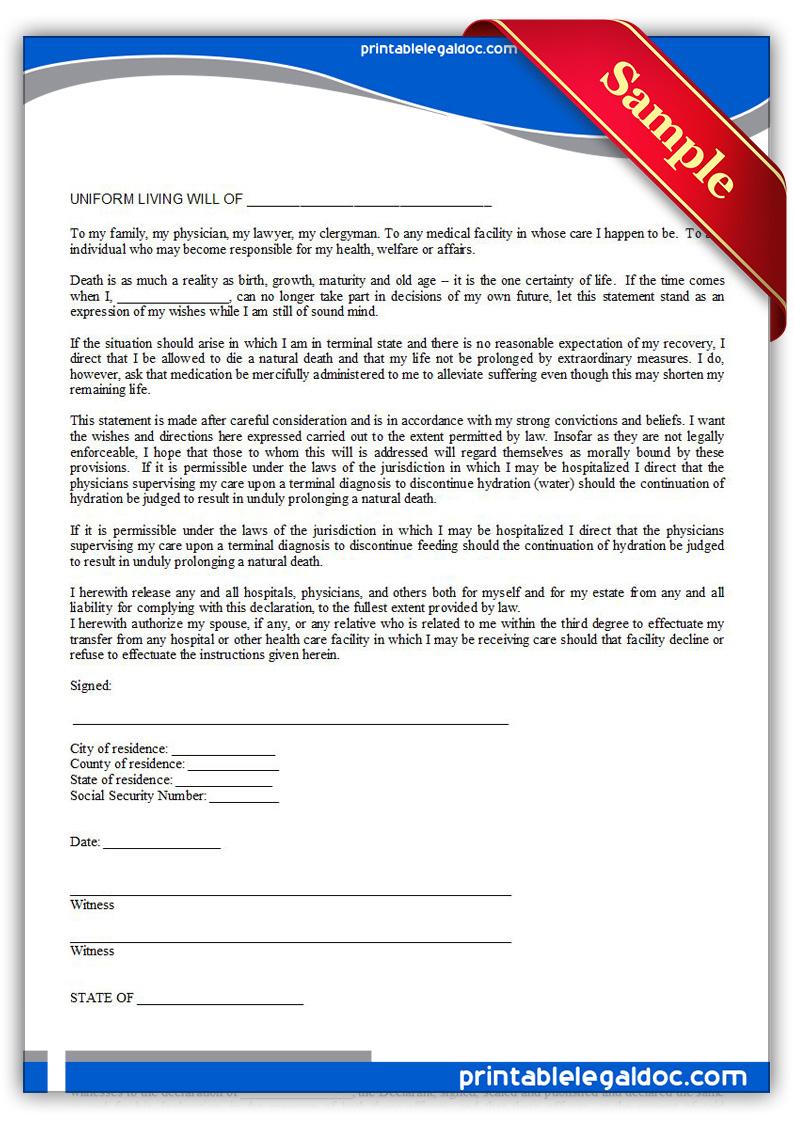
Life Sustaining Statute, Indiana
A Life Sustaining Statute or a uniform living will is a legal document written by someone who is diagnosed with an illness that may be difficult to cure or has a chance to become a terminal illness. A life sustaining statute or uniform living will states the wishes of the person who is ill. It states what they would want to happen in the case that their illness does become terminal or that they pass the point of no return. This document states the types of medications he will be restricted to and from. It also states that if the person decided to prolong or shorten his or her life, that he or she did it willingly, of sound mind, has been informed of possible treatments and procedures, and understands all legal implications of his or her decisions. The document is generally written (this may vary among states) with the writer’s signature, City of residence, County of residence, State of residence, Social Security Number, the Date it was signed, and the names of the witnesses present during this event. It is then presented to a notary public for notarization and publishing. Finally, you are encouraged to keep multiple copies. Make sure that theses can be accessible with your doctor, lawyer, and family members.
A life sustaining statute is generally legal in most states and will generally be enforce and made in the presence of witnesses and a notary public. There is a general format when it come to life sustaining statutes but the details may differ depending on the state you are in. In the state of Indiana, detailed statutory forms are prescribed.

Life Sustaining Statute, Indiana
Statutory Declaration in Conformance with Indiana Living Will and Life-Prolonging Procedures Act, Indiana Code 16-8-11-12
LIVING WILL DECLARATION OF ________________
Declaration made this __________ day of _________________ 20________.
I, _____________, being at least eighteen (18) years old and of sound mind, willfully and voluntarily make known my desires that my dying shall not be artificially prolonged under the circumstances set forth below, and I declare:
If at any time I should have an incurable and irreversible injury, disease, or illness certified in writing to be a terminal condition by my attending physician, and my attending physician has determined that my death will occur in a short period of time, and the use of life-prolonging procedures would serve only to artificially prolong the dying process, I direct that such procedures be withheld or withdrawn, and that I be permitted to die naturally with only the provision of appropriate nutrition and hydration and the administration of medication and the performance of any medical procedure deemed necessary to provide me with comfort care or to alleviate pain.
In the absence of my ability to give directions regarding the use of such life prolonging delaying procedures, it is my intention that this declaration shall be honored by my family and physician as the final expression of my legal right to refuse medical or surgical treatment and accept the consequences of the refusal.
I understand the full import of this declaration.
________________________________________
City of Residence: ____________________
County of Residence: __________________
State of Residence: ___________________
Date: _________________The Declarant has been personally known to me and I believe him or her to be of sound mind. I did not sign the Declarant’s signature above for or at the direction of the Declarant. I am not a parent, spouse, or child of the Declarant. I am not entitled to any part of the Declarant’s estate or directly financially responsible for Declarant’s medical care. I am competent and at least eighteen (18) years old.
Witness _________________________________________________
Witness _________________________________________________Date: _______________________
Statutory Declaration in Conformance with Indiana Living Will and Life-Prolonging Procedures Act, Indiana Code 16-8-11-12
Review ListThis review list is provided to inform you about this document in question and assist you in its preparation. This simple Life Sustaining Declaration is valid in Indiana. Check with a local hospital or doctor’s office, as well as with an experienced medical attorney, to assure yourself of its compliance with current statute (s) in your state.
1. Make multiple copies. Give one to your doctor (s), the local hospital, and have others available through your attorney and family. Remember, these kinds of documents are needed in emergency situations at worst and under stressful circumstances at best. So be sure they are available to the appropriate people easily, when needed.
Frequently Asked Questions
What is the Indiana Living Will Declaration?
The Indiana Living Will Declaration is a statutory document created under the Indiana Living Will and Life-Prolonging Procedures Act, Indiana Code 16-8-11-12. It allows a person to declare their wishes regarding the withholding or withdrawal of life-prolonging procedures if they have a terminal condition. The declaration must be made by an individual who is at least eighteen years old and of sound mind.
Who can make a living will in Indiana?
According to the article, a person must be at least eighteen (18) years old and of sound mind to make a living will declaration in Indiana. The declaration must be made willfully and voluntarily. The article does not specify any other eligibility requirements.
What conditions must be met for a living will to take effect in Indiana?
The living will takes effect if the person has an incurable and irreversible injury, disease, or illness that is certified in writing by the attending physician to be a terminal condition. Additionally, the attending physician must determine that death will occur in a short period of time. The use of life-prolonging procedures must serve only to artificially prolong the dying process.
What are life-prolonging procedures under Indiana law?
The article does not provide a specific definition of life-prolonging procedures. However, it indicates that such procedures are those that would serve only to artificially prolong the dying process when the person has a terminal condition. The declaration directs that these procedures be withheld or withdrawn.
What does a living will declaration direct regarding nutrition and hydration?
The declaration states that the person be permitted to die naturally with only the provision of appropriate nutrition and hydration. It also allows for the administration of medication and the performance of any medical procedure deemed necessary to provide comfort care or to alleviate pain. The article does not specify any limitations on nutrition and hydration beyond what is stated.
How does a living will affect pain management in Indiana?
The living will declaration explicitly permits the administration of medication and the performance of any medical procedure deemed necessary to provide comfort care or to alleviate pain. This means that pain management is not withheld even when life-prolonging procedures are withdrawn. The article does not address any specific medications or procedures.
What happens if I am unable to give directions regarding my care?
The article states that the declaration is made to express desires in the absence of the ability to give directions regarding care. It does not specify what happens if the person becomes unable to give directions after the declaration is made. The declaration itself serves as a guide for medical decisions.
Is a living will in Indiana legally binding?
The article presents the living will as a statutory declaration in conformance with the Indiana Living Will and Life-Prolonging Procedures Act. It indicates that the declaration is a legal document that makes known the person's desires. The article does not discuss enforceability or legal obligations of healthcare providers.
What is the difference between a living will and a life-sustaining statute in Indiana?
The article refers to the Indiana Living Will and Life-Prolonging Procedures Act, which governs living wills. It does not use the term "life-sustaining statute" or compare it to a living will. Therefore, no distinction is provided in the article.
Can I revoke my living will in Indiana?
The article does not mention revocation of a living will. It only describes the declaration and its directives. Therefore, no information about revoking a living will is available in the article.