Creditor Demand, Response To One
Creditor Demand, Response to One
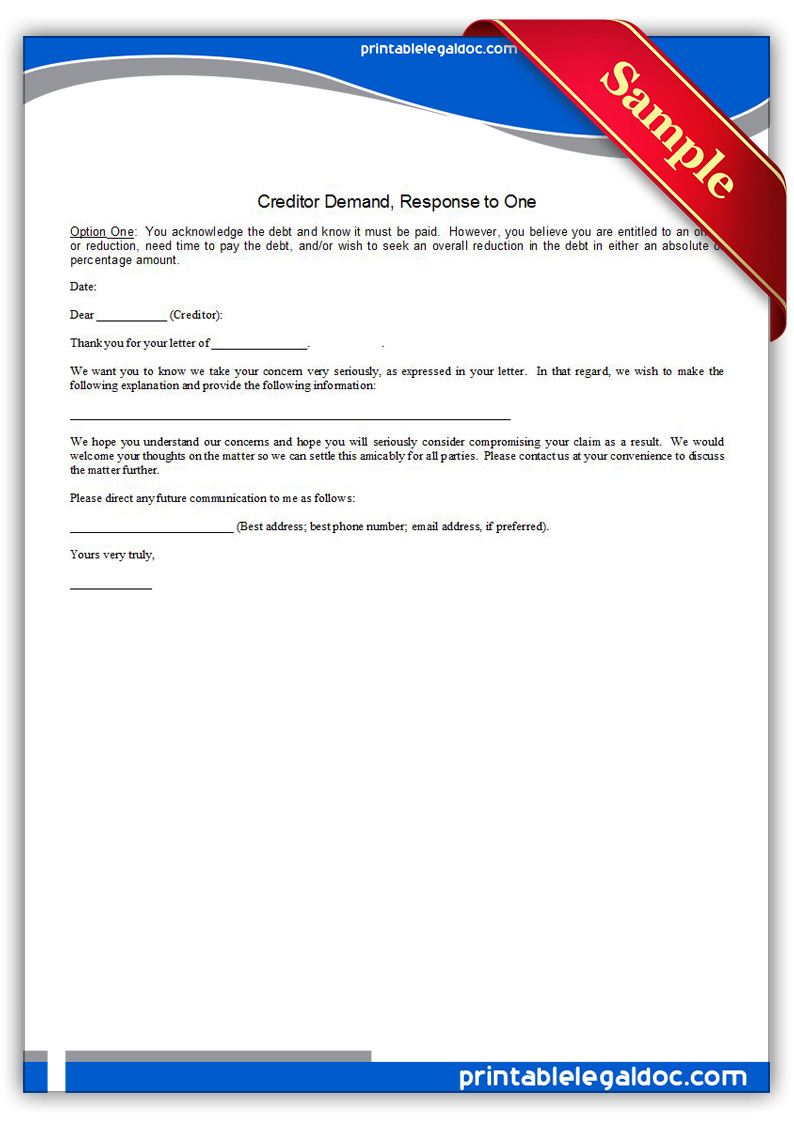
Option One: You acknowledge the debt and know it must be paid. However, you believe you are entitled to an offset or reduction, need time to pay the debt, and/or wish to seek an overall reduction in the debt in either an absolute or percentage amount.
Date:
Dear ___________ (Creditor):
Thank you for your letter of _______________. .
We want you to know we take your concern very seriously, as expressed in your letter. In that regard, we wish to make the following explanation and provide the following information:
______________________________________________________________________
We hope you understand our concerns and hope you will seriously consider compromising your claim as a result. We would welcome your thoughts on the matter so we can settle this amicably for all parties. Please contact us at your convenience to discuss the matter further.
Please direct any future communication to me as follows:
__________________________ (Best address; best phone number; email address, if preferred).
Yours very truly,
_____________
Option Two: You dispute the debt in question. It is not a secured debt so you feel comfortable in disputing it strongly because specific collateral cannot be liquidated under the claim (such as your car under an auto loan or house under a secured mortgage).
Date:
Dear ___________ (Creditor):
Thank you for your letter of _______________. .
We want you to know we take your concern seriously, as expressed in your letter. In that regard we wish to make the following explanation about our reasons for disputing this debt and provide the following information for your review:
______________________________________________________________________
You should recognize our position that this debt is disputed in its entirety for the reasons stated above. We welcome your thoughts on the matter so we can settle this amicably for all parties. Please contact us at your convenience to discuss the matter further.
Please direct any future communication to me as follows:
__________________________ (Best address; best phone number; email address, if preferred).
Yours very truly,_____________
Option Three: You acknowledge the debt in question and it is secured by collateral that is important to you (such as your car or house). You need time or a new plan to pay the indebtedness either because you simply do not have the money or temporary circumstances are preventing you from making all of the payments.Date:
Dear ___________ (Creditor):
Thank you for your letter of _______________. .
We want you to know we take your concern very seriously, as expressed in your letter. In that regard, we wish to make the following explanation about our reasons for currently not being able to pay our obligations in a timely manner. In that light, the following information is provided below for your review:
______________________________________________________________________
You should recognize our position that we owe this debt but are unable to pay it under the current payment plan because of the unfortunate circumstances stated above. We would welcome the opportunity, at your convenience, to discuss the matter more thoroughly and see if we can settle on a modified but temporary repayment plan until we can once again commit to making regular payments under the original payment plan.
Please contact us at your convenience to discuss the matter further and set up a meeting for a thorough discussion of possible options that will suit your needs and we can responsibly commit to making at this time.
Please direct any future communication to me as follows:
__________________________ (Best address; best phone number; email address, if preferred).
Yours very truly,_____________
Credit Demand, Response to
Review ListThis review list is provided to inform you about the document in question and to assist you in completing it.
1. You have one chance to make a first impression. It is important that your first contact with the other side is respectful and firm. Keep in mind that this is an occasional problem for you. It is their life. Collections is a very big business. This is personal for you but not for them, unless you make it that way. We encourage you to be respectful to them in all your conduct because they encounter that approach rarely and, like most people, will respond better to good treatment as long as you do not appear “weak” or “vulnerable.” In addition, more practically, the writer representing the creditor usually has substantial discretion to settle and revise indebtedness. If you are respectful and make a sound case, they will be more apt to use their discretion in your favor to reward your behavior and earn their fee at the same time. Therefore, you have the opportunity to have a win/win for both sides.
2. Your objective in your contact is to gauge what they can do. What are the limits of their authority to compromise your debt, eliminate the indebtedness entirely, and/or set up a new payment plan. Interestingly, most Collections people do not alert the debtor as to their ability to negotiate. As a result, a lot of deals don’t get done. Open-ended questions by you can get you a better sense of what they can do. Such questions are, “What can you do to settle this debt?” “What options can you present that your client might be willing to accept?” And so on and so on.
3. The writer or negotiator writing the letter, except in the case of a secured house or car loan, rarely expects to get “all” the money at once. They are authorized to compromise. You need to let them maintain the fiction of “higher authority” (that is, their client decides the final amount, etc., etc.) so they are able to show more concern for your side of the equation rather than be harsh with you in a one on one negotiation. This approach, then, helps both sides reach a meeting of the minds. You, too, can do the same thing. For example, “I would love to pay right now but my wife/husband/partner won’t abide by it.” You need to state this credibly so you relieve the harshness of the discussion; however, do not take it too far because the other side “knows” better.
4. After a preliminary conversation or meeting, you should have the parameters in mind and should be able to determine whether you can or cannot meet them. If you can, do it. If you cannot, then you probably have litigation in your future and should refer the matter over to a lawyer first for their advice and secondly to prepare any legal steps required in your defense.
5. As to the letter itself, you must sign it and include as much detail as possible about the whys and wherefores of the deal. Copies of the information related to this situation should be put together in a clear concise format. This enhances your position, in the eyes of the creditor, as to your being a responsible debtor and shows your preparation for negotiations. Set up your own file with the same copies. We recommend numbering your copies so you have an orderly file that can be referred to in sequence (that is, document 1, 2, 3 and so on).
6. As with any document in this CD, if you have any questions or concerns about your rights, responsibilities or obligations in this matter, consult an attorney.
Frequently Asked Questions
What is a creditor demand response?
A creditor demand response is a formal reply to a creditor's letter demanding payment. The article presents two options: one for acknowledging the debt and seeking compromise, and another for disputing the debt. The response should be tailored to your situation and sent to the creditor.
How do I respond to a creditor demand letter?
You can respond by choosing between two options outlined in the article. Option One involves acknowledging the debt and requesting an offset, reduction, or more time to pay. Option Two involves disputing the debt, especially if it is not secured. Your response should be in writing and include your contact information.
What should I include in a response to a creditor demand?
Your response should thank the creditor for their letter, state that you take their concern seriously, and provide an explanation or information. If you are acknowledging the debt, you may propose a compromise. Include your preferred contact information and direct future communication to yourself.
Can I negotiate a creditor demand?
Yes, Option One in the article is designed for negotiating a creditor demand. You can acknowledge the debt while seeking an offset, reduction, or more time to pay. The article suggests asking the creditor to consider compromising their claim and inviting further discussion.
What is the difference between acknowledging and disputing a debt?
Acknowledging a debt means you agree it is owed and must be paid, but you may seek a reduction or time to pay. Disputing a debt means you disagree with the claim, and the article notes you might feel comfortable disputing strongly if it is not a secured debt. The choice depends on your circumstances.
How do I dispute a creditor demand?
To dispute a creditor demand, you would use Option Two as described in the article. This option is for when you dispute the debt in question. The article indicates that if the debt is not secured, you may feel comfortable disputing it strongly.
What is a secured debt?
The article mentions secured debt in the context of disputing a debt. It implies that a secured debt is one where the creditor has collateral, making it riskier to dispute. However, the article does not provide a full definition.
Should I respond to a creditor demand letter?
Yes, responding is important to address the creditor's concern. The article provides templates for both acknowledging and disputing the debt. Ignoring the letter may lead to further action, so a timely response is advisable.
What happens if I ignore a creditor demand?
The article does not specify consequences of ignoring a creditor demand. However, it emphasizes taking the creditor's concern seriously and responding appropriately. Ignoring may result in escalated collection efforts or legal action, but this is not stated in the article.
How do I ask for more time to pay a debt?
In Option One, you can acknowledge the debt and request more time to pay. The article suggests explaining your situation and asking the creditor to consider compromising their claim. You should propose a timeline or ask to discuss further.