
<

Mediation Agreement
Mediation Agreement
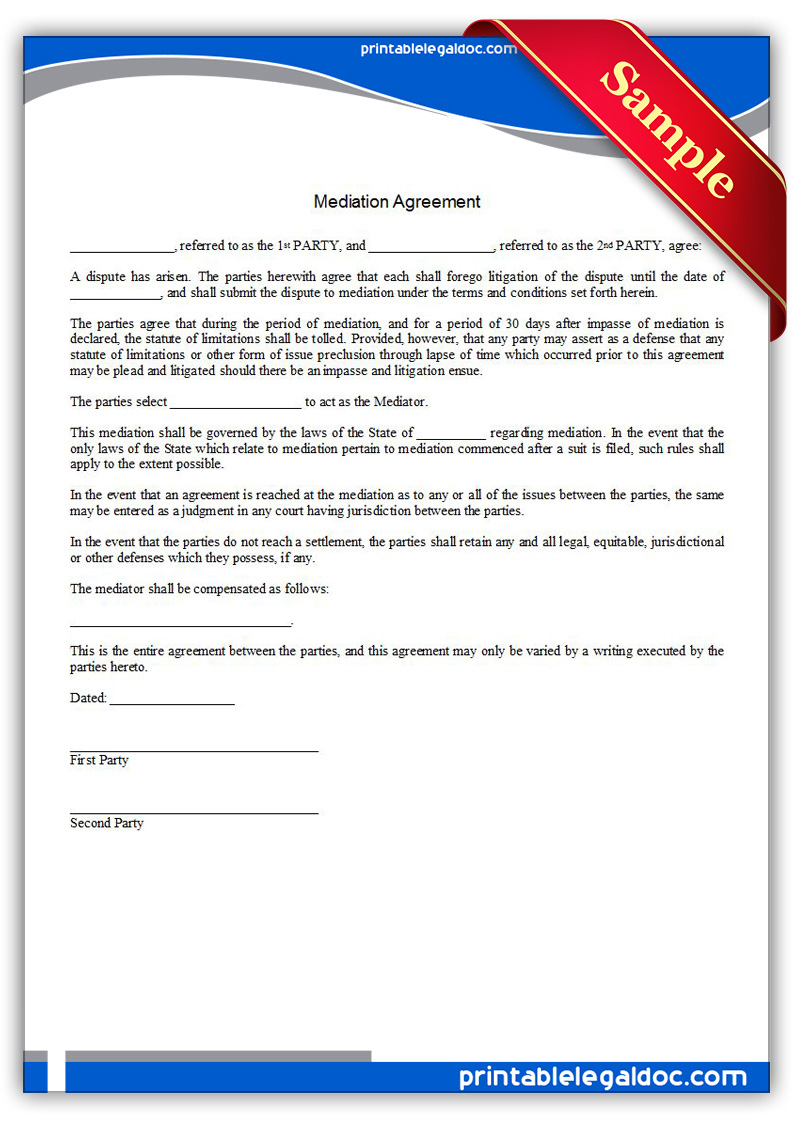
_______________, referred to as the 1st PARTY, and __________________, referred to as the 2nd PARTY, agree:
A dispute has arisen. The parties herewith agree that each shall forego litigation of the dispute until the date of _____________, and shall submit the dispute to mediation under the terms and conditions set forth herein.
The parties agree that during the period of mediation, and for a period of 30 days after impasse of mediation is declared, the statute of limitations shall be tolled. Provided, however, that any party may assert as a defense that any statute of limitations or other form of issue preclusion through lapse of time which occurred prior to this agreement may be plead and litigated should there be an impasse and litigation ensue.
The parties select ___________________ to act as the Mediator.
This mediation shall be governed by the laws of the State of __________ regarding mediation. In the event that the only laws of the State which relate to mediation pertain to mediation commenced after a suit is filed, such rules shall apply to the extent possible.
In the event that an agreement is reached at the mediation as to any or all of the issues between the parties, the same may be entered as a judgment in any court having jurisdiction between the parties.
In the event that the parties do not reach a settlement, the parties shall retain any and all legal, equitable, jurisdictional or other defenses which they possess, if any.
The mediator shall be compensated as follows:
________________________________.
This is the entire agreement between the parties, and this agreement may only be varied by a writing executed by the parties hereto.
Dated: __________________
____________________________________
First Party
____________________________________
Second Party
Mediation Agreement
Review ListThis review list has been provided to inform you about this document in question and assist you in its preparation. Mediations are a good beginning to ending a dispute. Even if the mediation does not result in a final settlement, it tends to bring the parties together-and often leads to a later settlement prior to trial.
1. Make multiple copies. Give one to each signatory. Keep one with the transaction file.
2. Mediations are a form of negotiations and more advice is available in our Negotiations disc. In short, if the parties can work together in the future, then mediations should emphasize these future benefits and construct an agreement around these future opportunities (e.g., one party gives the other a discount off the price of future purchases).
Frequently Asked Questions
What is a mediation agreement?
A mediation agreement is a contract in which parties to a dispute agree to submit their dispute to mediation instead of litigating immediately. It typically identifies the parties, the mediator, the governing law, and the terms of the mediation process. The agreement may also include provisions such as tolling the statute of limitations during mediation.
What does it mean that the statute of limitations is tolled in a mediation agreement?
Tolling means that the time period for filing a lawsuit is paused during the mediation and for 30 days after an impasse is declared. This prevents a party from losing their right to sue because the limitation period expires while mediation is ongoing. The agreement specifies that the statute of limitations is tolled during mediation and for 30 days after impasse.
Can a party still file a lawsuit after signing a mediation agreement?
The parties agree to forego litigation until a specified date and to submit the dispute to mediation. However, if mediation ends in impasse, litigation may ensue. Any party may also assert defenses based on statutes of limitations or issue preclusion that occurred prior to the agreement.
What happens if mediation results in an impasse?
If mediation results in an impasse, the parties may proceed to litigation. The statute of limitations remains tolled for 30 days after the impasse is declared. Additionally, any defenses related to the lapse of time before the agreement can be raised in the subsequent litigation.
How is the mediator selected in a mediation agreement?
The mediation agreement includes a blank space where the parties can name the mediator. The selected mediator is then identified in the agreement. The agreement does not specify any particular method for selection beyond naming the individual.
What law governs the mediation agreement?
The mediation is governed by the laws of the State specified in the agreement regarding mediation. If the only laws of that State relating to mediation apply to mediation commenced after a suit is filed, those rules shall apply to the extent possible. The agreement allows the parties to choose the governing state law.
What should be included in a mediation agreement?
A mediation agreement should include the names of the parties, a statement that a dispute has arisen, the agreement to forego litigation until a certain date, the agreement to submit to mediation, the tolling of the statute of limitations, the selection of the mediator, and the governing law. It may also address the outcome if an agreement is reached at mediation.
Is a mediation agreement legally binding?
Yes, a mediation agreement is a contract between the parties and is legally binding according to its terms. It is governed by the laws of the specified State regarding mediation. The agreement outlines the parties' obligations and the consequences of impasse.
What is the purpose of the 30-day tolling period after impasse?
The 30-day tolling period after impasse provides the parties with additional time to file a lawsuit without the statute of limitations expiring. It ensures that the time spent in mediation does not count against the limitation period. This gives parties a window to transition from mediation to litigation if needed.
Can pre-existing statute of limitations defenses be raised after mediation?
Yes, the agreement allows any party to assert as a defense that any statute of limitations or other form of issue preclusion through lapse of time which occurred prior to the agreement may be pleaded and litigated if there is an impasse and litigation ensues. This means that defenses based on time that elapsed before the mediation agreement was signed are preserved. The agreement explicitly permits such defenses to be raised.