
Right Of Way Agreementmutual
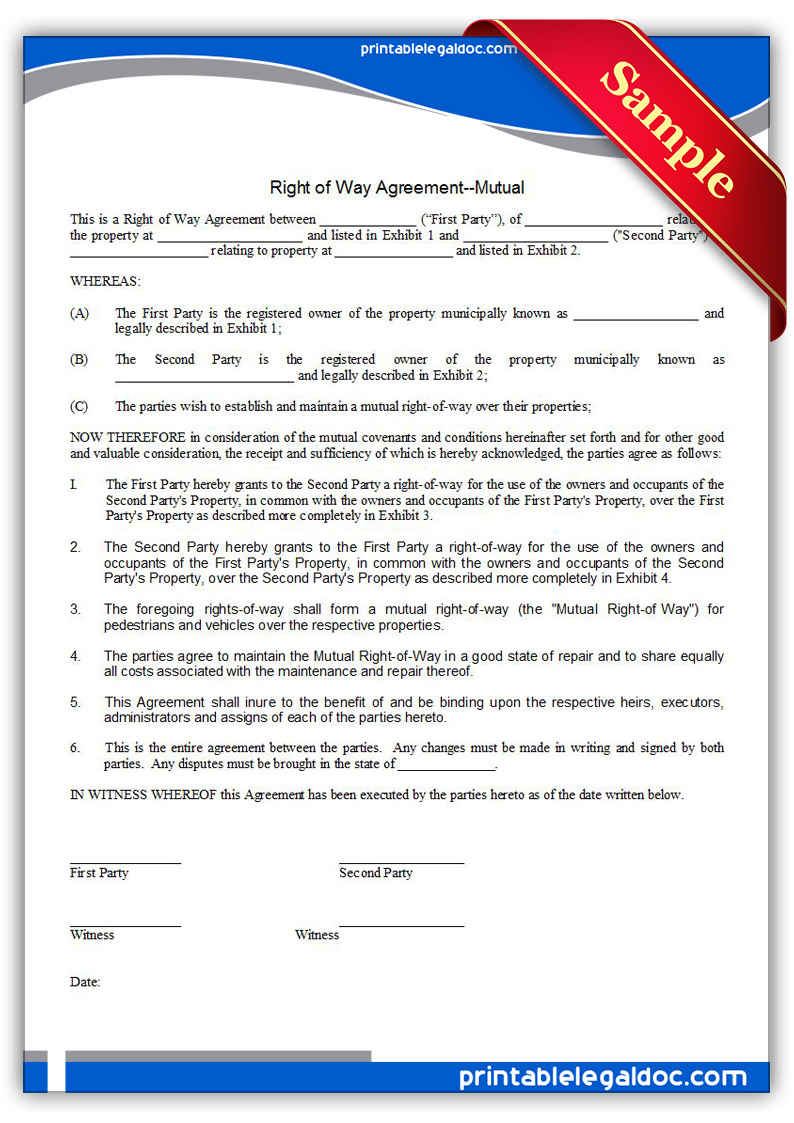
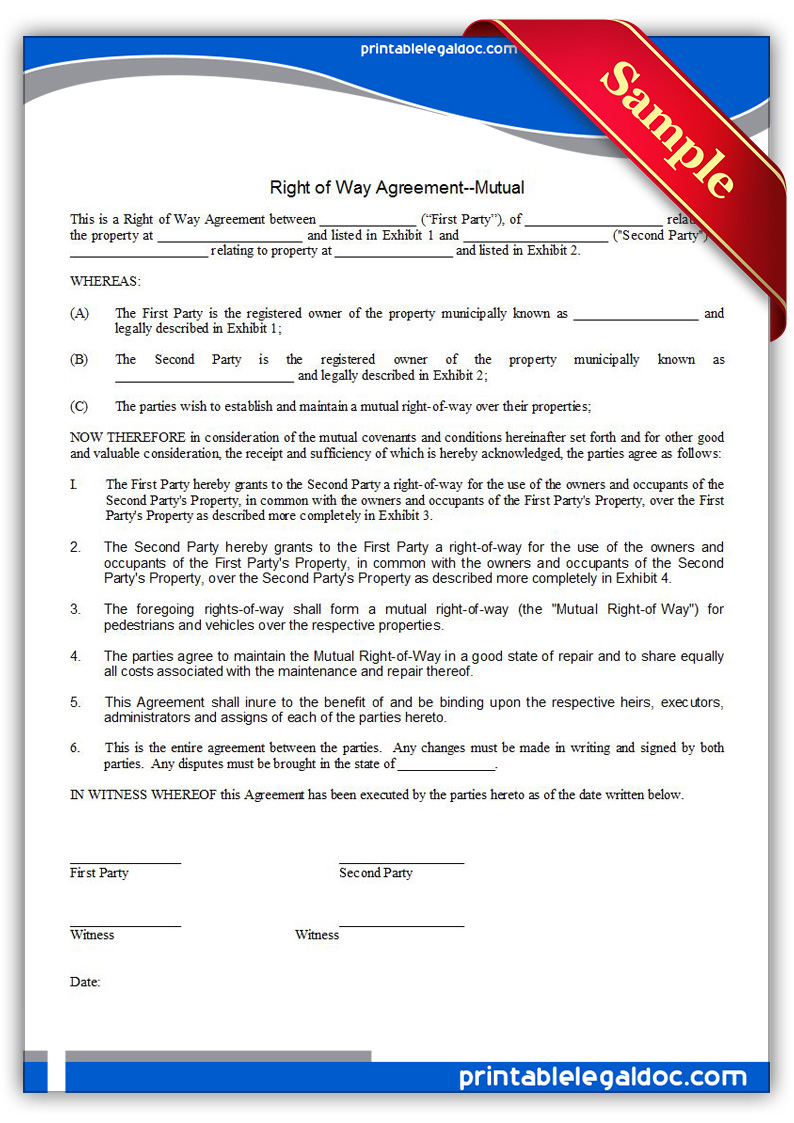
Right of Way Agreement–Mutual
This is a Right of Way Agreement between ______________ (“First Party”), of ____________________ relating to the property at _____________________ and listed in Exhibit 1 and _____________________ (“Second Party”) of ____________________ relating to property at _________________ and listed in Exhibit 2.
WHEREAS:
(A) The First Party is the registered owner of the property municipally known as __________________ and legally described in Exhibit 1;
(B) The Second Party is the registered owner of the property municipally known as __________________________ and legally described in Exhibit 2;
(C) The parties wish to establish and maintain a mutual right-of-way over their properties;
NOW THEREFORE in consideration of the mutual covenants and conditions hereinafter set forth and for other good and valuable consideration, the receipt and sufficiency of which is hereby acknowledged, the parties agree as follows:
I. The First Party hereby grants to the Second Party a right-of-way for the use of the owners and occupants of the Second Party’s Property, in common with the owners and occupants of the First Party’s Property, over the First Party’s Property as described more completely in Exhibit 3.
2. The Second Party hereby grants to the First Party a right-of-way for the use of the owners and occupants of the First Party’s Property, in common with the owners and occupants of the Second Party’s Property, over the Second Party’s Property as described more completely in Exhibit 4.
3. The foregoing rights-of-way shall form a mutual right-of-way (the “Mutual Right-ofWay”) for pedestrians and vehicles over the respective properties.
4. The parties agree to maintain the Mutual Right-of-Way in a good state of repair and to share equally all costs associated with the maintenance and repair thereof.
5. This Agreement shall inure to the benefit of and be binding upon the respective heirs, executors, administrators and assigns of each of the parties hereto.
6. This is the entire agreement between the parties. Any changes must be made in writing and signed by both parties. Any disputes must be brought in the state of ______________.
IN WITNESS WHEREOF this Agreement has been executed by the parties hereto as of the date written below.
________________ __________________
First Party Second Party
________________ __________________
Witness Witness
Date:
Right of Way Agreement-Mutual
Review ListThis review list is provided to inform you about this document in writing and assist you in its preparation. This agreement should be recorded on your deed to preserve your rights. If you give a right of way to another party, without a compensating right of way in return, you should consider selling those rights and add a clause herein to reflect that compensation to you.
1. Make multiple copies. Consider getting the document notarized since you should file it with the registry of deeds. Keep a copy with your property papers that relate to the right of way.
Frequently Asked Questions
What is a mutual right of way agreement?
A mutual right of way agreement is a legal contract between two property owners that grants each party a right-of-way over the other's property. It is used when both parties need access across each other's land, and it establishes the terms for that shared use. The agreement is based on mutual covenants and consideration, as described in the provided text.
When should I use a mutual right of way agreement?
You should use a mutual right of way agreement when you and a neighboring property owner wish to establish and maintain a mutual right-of-way over your properties. This situation typically arises when both properties require access that crosses the other's land. The agreement formalizes the arrangement and ensures both parties' rights are protected.
Who are the parties in a mutual right of way agreement?
The parties are the First Party and the Second Party, both of whom are registered owners of their respective properties. The First Party owns the property described in Exhibit 1, and the Second Party owns the property described in Exhibit 2. Their details, including names and property addresses, are filled into the agreement's template.
What is the purpose of a mutual right of way agreement?
The purpose is to establish and maintain a mutual right-of-way over the parties' properties. It allows the owners and occupants of each property to use the other's property for access, in common with each other. This ensures both parties have the necessary rights and obligations clearly defined.
What does a mutual right of way agreement grant?
The agreement grants each party a right-of-way over the other's property for the use of their respective owners and occupants. Specifically, the First Party grants the Second Party a right-of-way over the First Party's property, and vice versa, as outlined in the agreement. This right is held in common with the owners and occupants of the granting party's property.
How is a mutual right of way agreement structured?
The agreement begins with the identification of the parties and their properties, followed by recitals (WHEREAS clauses) that state the ownership and the desire to establish a mutual right-of-way. The operative clauses then set out the grants and terms, starting with the First Party's grant to the Second Party. The document is designed to be completed with specific details in the blanks and exhibits.
What is included in Exhibit 1 and Exhibit 2 in a mutual right of way agreement?
Exhibit 1 contains the legal description of the First Party's property, and Exhibit 2 contains the legal description of the Second Party's property. These exhibits are referenced in the agreement to precisely identify the properties subject to the right-of-way. The municipal addresses are also stated in the agreement for clarity.
What consideration is required for a mutual right of way agreement?
The agreement states that it is made in consideration of the mutual covenants and conditions set forth and for other good and valuable consideration, the receipt and sufficiency of which is acknowledged. This means that the mutual promises and benefits exchanged by the parties serve as consideration. No specific monetary amount is required by the text.
Can a mutual right of way agreement be used for both residential and commercial properties?
The provided text does not specify any limitation on the type of properties; it simply refers to properties owned by the First Party and Second Party. The agreement is designed to be adaptable to any properties that require a mutual right-of-way. However, the text does not explicitly address residential or commercial use.
What are the key elements of a mutual right of way agreement?
Key elements include the identification of the parties and their properties, recitals establishing ownership and intent, and the grant of mutual rights-of-way. The agreement also includes provisions for consideration and references to exhibits for legal descriptions. The specific terms of use are detailed in the operative clauses, beginning with the First Party's grant.



Love your printable legal forms!
Its so awsome.Thank you for sharing your free printable templates.
Ah, very nice! I like your printable template.
Luv this and luv your blank word template! Thank you!
How do you print them? I can’t even figure out to do that???
thx for sharing your sample form!I love it so much !!!!!
I discovered you today. You do things fantastic. BRAVO
These are so sweet. I love your printable form.
So professionally written!!! Many thanks!
This is soo brilliant form :3 Oh yes..