

This Accounts Receivable Agreement review list is given to assist you in the preparation of this document. Given the nature of financial transactions, this document will most likely only be used in private transactions, since most financial institutions depend on the use of their own documents. Mainly, this is done to ensure that all agreements for similar financial instruments are the same, so that bankers, collectors, and lawyers know exactly what their rights and obligations are, down to the comma and beyond. To be sure, this instrument may be utilized to obtain private funding in a more secure way than a pure equity transaction, if done correctly. This is particularly true given the fact that the stock market seems to be in a sideways trend for the time being.
- Make sure that at all parties sign the agreement in at least two copies, and that you maintain an additional copy in both your corporate minute book (since this kind of transaction needs Board permission) and your banking/lending file. 2. You might consider keeping a third copy of this document in your business records, either at home or at the office, just as you would with other important corporate papers.
- Because of the severity of this Agreement, as well as the associated expense, you should consider carefully before taking this kind of financing in lieu of alternative types of loan and equity. If your accounts are in good standing and your payments are within defined limitations, this kind of arrangement may be beneficial (it has for me in the past). However, if chargebacks and disputes play a major part in your accounts receivable, as they often do in the high-tech world, you should be aware of the implications for conventional accounts receivable financing, which is what this is. The paperwork involved in backing out and accounting for each one of these transactions tends to undermine the lender’s trust in the borrower’s ability to pay. For them, chargebacks are poison, but discounts that have been discussed and agreed upon are another thing. A clean A/R ledger that they can depend on is very important to a lender since this is the collateral they are lending against. Trying to do anything else is usually problematic—not to forget time demanding for all parties involved.
- Finally, regardless of the exact terms of the agreement, this kind of loan is time-consuming and costly to administer, regardless of the circumstances. Most of the time, it requires considerable managerial supervision. Simply Media is delighted to be able to operate without the need for external funding. To summarize, this kind of financing may provide you with much-needed operating cash if you are in desperate need of it. Nevertheless, it comes with a hefty cost, in addition to the real expenses of borrowing the money. Because most agreements are more readily entered into than departed, and this one is no different, it is important to thoroughly and realistically consider the implications of depending on this kind of funding before entering one.
Accounts Receivable, All Accounts
Accounts Receivable, All Accounts
For valuable consideration, the receipt and sufficiency of which is hereby acknowledged, the undersigned assigns and transfers to __________________________ (“Assignee”) the accounts receivable (“Accounts Receivable”) as a general and continuing collateral security for payment of all existing and future indebtedness and liability of the undersigned to the Assignee and any ultimate unpaid balance thereof, and as a first and prior claim upon the Accounts Receivable. The undersigned further agrees as follows:
1. The Assignee may collect, sell or otherwise deal with the Accounts Receivable or any part thereof in such manner, upon such terms and conditions and at such time or times as may seem to it advisable and without notice to the undersigned (except as otherwise required by applicable law), and may charge on its own behalf and pay to others reasonable sums for expenses incurred and for services rendered (expressly including legal advice and services) in or in connection with collecting, realizing, selling or obtaining payment of the Accounts Receivable and may add the amount of such sums to the indebtedness of the undersigned.
2. The Assignee shall not be liable or accountable for any failure to collect, realize, sell or obtain payment of the Accounts Receivable or any part thereof and shall not be bound to institute proceedings for the purpose of collecting, realizing or obtaining payment of the same or for the purpose of preserving any rights of the Assignee, the undersigned or any other person, firm or corporation in respect of the same.
3. The Assignee may grant extensions of time and other indulgences, take and give up securities, accept compositions, grant releases and discharges and otherwise deal with the undersigned, debtors of the undersigned, sureties and others and with the Accounts Receivable and other securities as the Assignee may see fit without prejudice to the liability of the undersigned or the Assignee’s right to hold and realize this security.
4. All moneys collected or received by the undersigned in respect of the Accounts Receivable shall be received as trustee for the Assignee and shall be forthwith paid to the Assignee.
5. All moneys collected or received by the Assignee in respect of the Accounts Receivable (whether by virtue of paragraph 4 or otherwise) may be applied on account of such parts of the indebtedness and liability of the undersigned as to the Assignee seems best or in the discretion of the Assignee may be released to the undersigned, all without prejudice to the Assignee’s claims upon the undersigned.
6. The undersigned shall on request furnish to the Assignee in writing all information requested relating to the Accounts Receivable and the Assignee shall be entitled to inspect the securities, bills, notes, books, papers and other documents or take temporary custody thereof and for such purposes the Assignee shall have access to all premises occupied by the undersigned.
7. The undersigned shall on the Assignee’s request do, make and execute all such financing statements, further assignments, documents, acts, matters and things as may be required by the Assignee of or with respect to the Accounts Receivable or any part thereof or as may be required to give effect to these presents, including, but not limited to obtaining waivers and subordinations of interests in the Accounts Receivable from any persons having a prior claim or interest thereto. The undersigned hereby constitutes and appoints the Assignee the true and lawful attorney of the undersigned irrevocable with full power or substitution to do, make and execute all such statements, assignments, documents, acts, matters or things with the right to use the name of the undersigned whenever and wherever it may be deemed necessary or expedient.
8. The provisions hereof shall go to the benefit of the successors and assigns of the Assignee and shall be binding upon the respective heirs, executors, administrators, successors and assigns of the undersigned.
9. Notices.
Any notice required by this Agreement or given in connection with it, shall be in writing and shall be given to the appropriate party by personal delivery or a recognized over night delivery service such as FedEx.
If to the Assignee: _____________________________________________________.
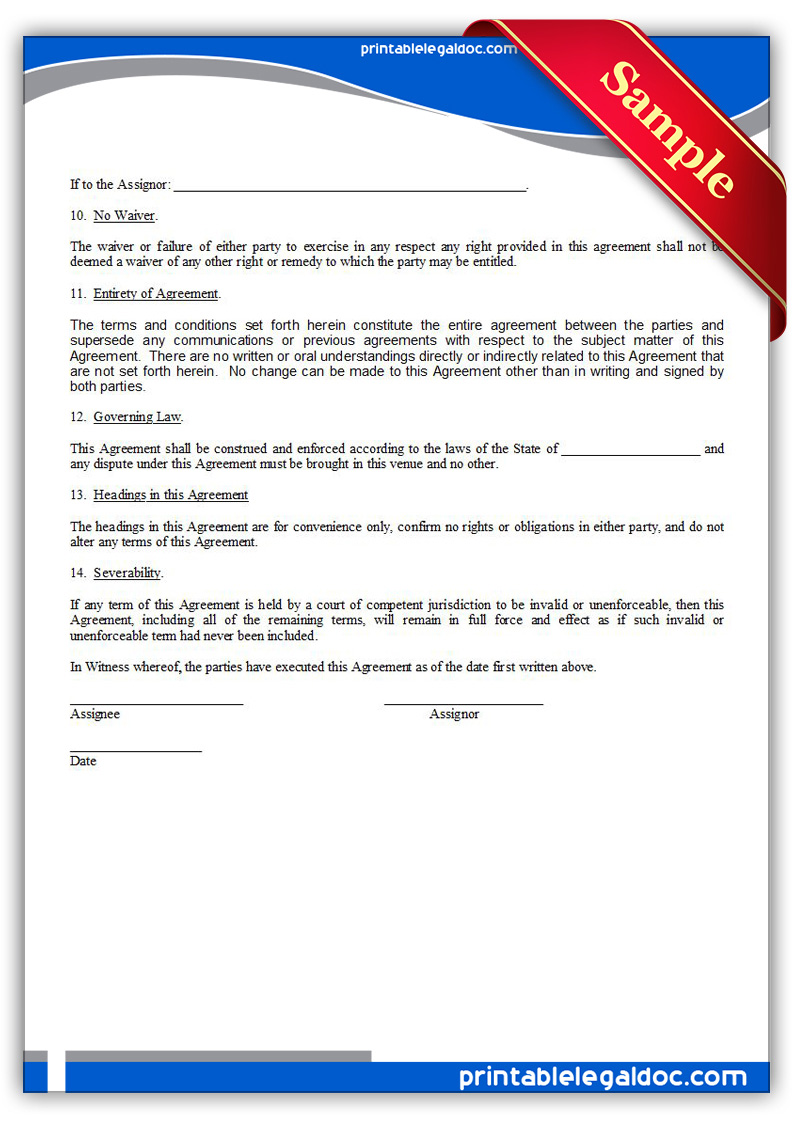
If to the Assignor: ___________________________________________________.
10. No Waiver.
The waiver or failure of either party to exercise in any respect any right provided in this agreement shall not be deemed a waiver of any other right or remedy to which the party may be entitled.
11. Entirety of Agreement.
The terms and conditions set forth herein constitute the entire agreement between the parties and supersede any communications or previous agreements with respect to the subject matter of this Agreement. There are no written or oral understandings directly or indirectly related to this Agreement that are not set forth herein. No change can be made to this Agreement other than in writing and signed by both parties.
12. Governing Law.
This Agreement shall be construed and enforced according to the laws of the State of ____________________ and any dispute under this Agreement must be brought in this venue and no other.
13. Headings in this Agreement
The headings in this Agreement are for convenience only, confirm no rights or obligations in either party, and do not alter any terms of this Agreement.
14. Severability.
If any term of this Agreement is held by a court of competent jurisdiction to be invalid or unenforceable, then this Agreement, including all of the remaining terms, will remain in full force and effect as if such invalid or unenforceable term had never been included.
In Witness whereof, the parties have executed this Agreement as of the date first written above.
_________________________ _______________________
Assignee Assignor___________________
Date
Frequently Asked Questions
What is an Accounts Receivable, All Accounts assignment?
An Accounts Receivable, All Accounts assignment is a legal document in which the undersigned assigns and transfers all accounts receivable to an assignee as general and continuing collateral security for payment of all existing and future indebtedness and liability. It also creates a first and prior claim upon the accounts receivable. This means the assignee has a priority interest in the receivables.
What does it mean that the assignment is for valuable consideration?
The phrase 'for valuable consideration, the receipt and sufficiency of which is hereby acknowledged' indicates that something of value was exchanged to make the assignment binding. It confirms that the assignor received consideration and acknowledges its sufficiency. This is a standard legal formality.
What rights does the assignee have under this agreement?
The assignee may collect, sell, or otherwise deal with the accounts receivable or any part thereof in such manner, upon such terms and conditions, and at such time or times as may seem advisable. The assignee may act without notice to the undersigned, except as otherwise required by applicable law. The assignee may also charge and pay reasonable sums for expenses and services, including legal advice, and add those amounts to the indebtedness.
Can the assignee collect the accounts receivable without notifying the assignor?
Yes, the agreement states that the assignee may collect, sell, or otherwise deal with the accounts receivable without notice to the undersigned, except as otherwise required by applicable law. This means that in most cases, the assignee can take collection actions without prior notification. However, applicable law may impose notice requirements in certain situations.
What expenses can the assignee charge to the assignor?
The assignee may charge on its own behalf and pay to others reasonable sums for expenses incurred and for services rendered in connection with collecting, realizing, selling, or obtaining payment of the accounts receivable. This expressly includes legal advice and services. The amount of such sums may be added to the indebtedness of the undersigned.
Does this assignment cover future debts as well as existing ones?
Yes, the assignment is a general and continuing collateral security for payment of all existing and future indebtedness and liability of the undersigned to the assignee. It also covers any ultimate unpaid balance thereof. This means it secures both current and future obligations.
What is the priority of the assignee's claim on the accounts receivable?
The assignment creates a first and prior claim upon the accounts receivable. This means the assignee's interest takes precedence over other claims, subject to applicable law. It ensures the assignee has priority in receiving payment from the receivables.
Is the assignor still responsible for the debts after assigning the accounts receivable?
Yes, the assignment is collateral security for payment of the indebtedness, so the assignor remains liable for any unpaid balance. The assignee's ability to collect and add expenses to the indebtedness further indicates the assignor's ongoing obligation. The assignment does not discharge the underlying debt.
What legal advice and services can the assignee obtain and charge for?
The assignee may obtain legal advice and services in connection with collecting, realizing, selling, or obtaining payment of the accounts receivable. The reasonable sums for such services can be charged to the assignor and added to the indebtedness. This is expressly included in the expenses the assignee may incur.
What happens if the assignee sells the accounts receivable?
The assignee has the right to sell the accounts receivable or any part thereof, upon such terms and conditions and at such time or times as may seem advisable. The assignee may do so without notice to the undersigned, except as required by law. The proceeds would be applied according to the agreement and applicable law.


Thank you so much for sharing this sample template with us!
This is amazing! You did such a great job in writing the blank template
Thanks for sharing
very nice .. thank you
stunning dear ^^
Love your printable legal forms!
Its so awsome.Thank you for sharing your free printable templates.
Ah, very nice! I like your printable template.
Luv this and luv your blank word template! Thank you!
How do you print them? I can’t even figure out to do that???