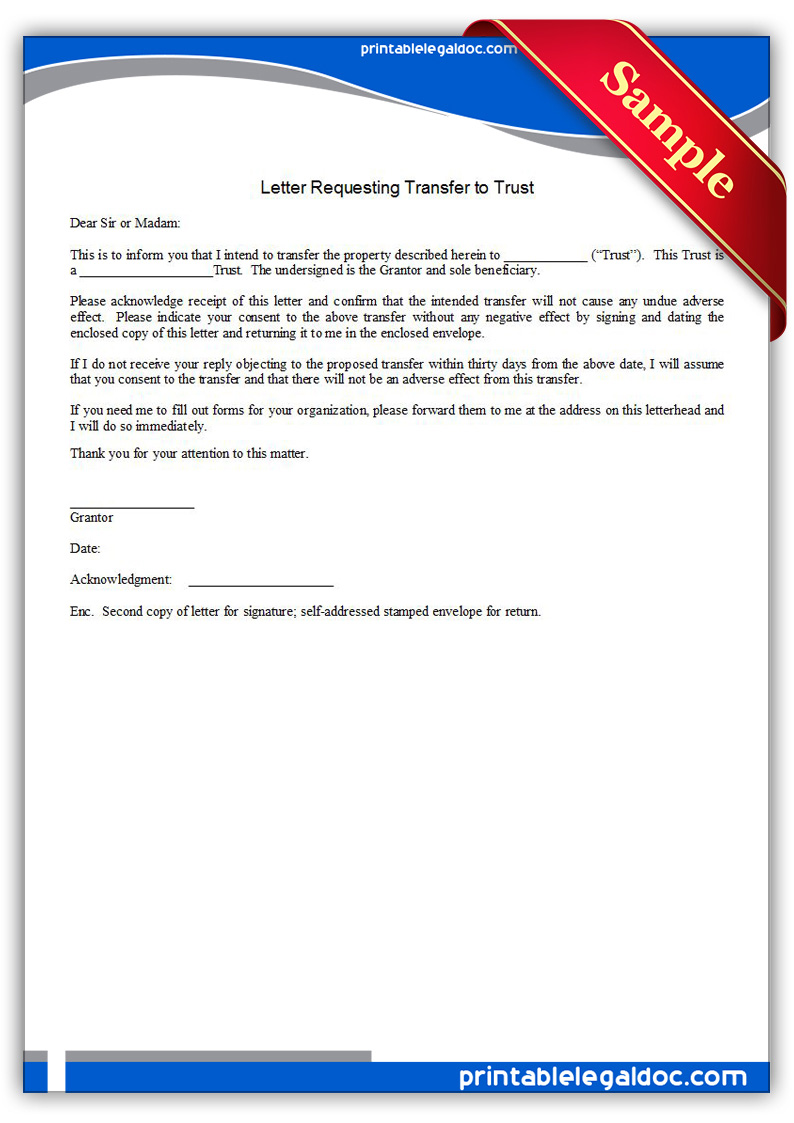

Letter Requesting Transfer to Trust
A Trust is a legal document containing a formal agreement between parties in which one party grants or vests the ownership rights (title) to one or more trustees for the purposes of conservation, protection, or preservation on behalf of the first party or beneficiary of the trust. This instrument normally and usually states: The reasons and purposes as to why the trust was established and the actions that will terminate the trust, a detailed record of what assets are placed and present in the trust, the authority and boundaries of the said trustees, the reporting requirements of the trustees, and other provisions associated to the trust. It may also state the compensation that the trustees will be receiving, if there are any.
A Letter requesting transfer to trust is a legal document or legal instrument used to inform a certain individual of the transferring of items, that have deeds or titles such as properties or vehicles, stated within a living trust. A letter requesting transfer to trust is used so that an individual may transfer valuable items into a living trust for protection or preservation. A letter requesting transfer to trust will have a receipt which the Grantor and sole beneficiary will be required to sign. If there is a failure to sign the aforementioned document within 30 days from the said date, the assumption of consent will be accepted and the transfer will occur without an adverse effect. You are encouraged to keep copies of this form in specific transactions and general files. This form is revocable.

Letter Requesting Transfer To Trust
Letter Requesting Transfer to Trust
Dear Sir or Madam:
This is to inform you that I intend to transfer the property described herein to ____________ (“Trust”). This Trust is a ___________________Trust. The undersigned is the Grantor and sole beneficiary.
Please acknowledge receipt of this letter and confirm that the intended transfer will not cause any undue adverse effect. Please indicate your consent to the above transfer without any negative effect by signing and dating the enclosed copy of this letter and returning it to me in the enclosed envelope.
If I do not receive your reply objecting to the proposed transfer within thirty days from the above date, I will assume that you consent to the transfer and that there will not be an adverse effect from this transfer.
If you need me to fill out forms for your organization, please forward them to me at the address on this letterhead and I will do so immediately.
Thank you for your attention to this matter.__________________
GrantorDate:
Acknowledgment: _____________________
Enc. Second copy of letter for signature; self-addressed stamped envelope for return.
Letter Requesting Transfer to Trust
Review ListThis review list is provided to inform you about this document in question and assist you in its preparation. Adapt this letter to fit the circumstances of the various parties you must contact to collect your assets, have them properly transferred to your new trust, and be prepared to follow-up diligently to be sure all of the paperwork is in order. This is a serious and extended task. Do not enter into it lightly or expect it to go smoothly. You have just entered administrative hell….
1. Set up a file for follow-up on all of these transactions. Keep separate copies in each specific transaction file but also in the general file.
2. Follow-up by phone within 14 days of sending out each letter, if you have not heard back.
3. If you decide to revoke your Trust at any time, use the same approach in reverse.
Frequently Asked Questions
What is a letter requesting transfer to trust?
A letter requesting transfer to trust is a formal written communication used to inform a party that the sender intends to transfer property to a trust. It identifies the trust, states that the undersigned is the Grantor and sole beneficiary, and requests acknowledgment and consent to the transfer. The letter also includes a provision for deemed consent if no objection is received within thirty days.
Who should use a letter requesting transfer to trust?
This letter is used by a Grantor who is also the sole beneficiary of a trust and wishes to transfer property into that trust. It is typically sent to an entity or individual holding the property or having an interest in the transfer, such as a financial institution or a title company. The letter helps facilitate the transfer by obtaining formal acknowledgment and consent.
What information must be included in a letter requesting transfer to trust?
The letter must include the name of the trust, the type of trust, and a statement that the undersigned is the Grantor and sole beneficiary. It should describe the property being transferred and request acknowledgment and consent to the transfer without adverse effect. The letter also provides a thirty-day window for objections and instructions for returning a signed copy.
How long does the recipient have to respond to a letter requesting transfer to trust?
The recipient has thirty days from the date of the letter to respond with any objection to the proposed transfer. If no objection is received within that period, the sender will assume consent and that there will be no adverse effect from the transfer. This deadline is explicitly stated in the letter to encourage a timely response.
What happens if the recipient does not respond to the letter requesting transfer to trust?
If the recipient does not respond within thirty days, the sender will assume that the recipient consents to the transfer and that there will not be an adverse effect. This assumption is based on the language in the letter, which states that silence will be treated as consent. It is important for recipients to respond promptly if they have any objections.
Is a letter requesting transfer to trust legally binding?
The letter itself is not a legally binding document; it is a request for acknowledgment and consent. However, it can serve as evidence of the sender's intent to transfer property to the trust and of the recipient's consent if they sign and return the letter. The thirty-day deemed consent provision may have legal implications depending on applicable law, so it is advisable to consult a legal professional.
What should I do if I need to fill out forms for the recipient's organization?
If the recipient requires specific forms, the letter requests that they forward those forms to the sender at the address on the letterhead. The sender commits to filling them out immediately upon receipt. This ensures that the transfer process can proceed smoothly and in accordance with the recipient's procedures.
What enclosures should be included with a letter requesting transfer to trust?
The letter should include a second copy of the letter for the recipient to sign and date, as well as a self-addressed stamped envelope for its return. These enclosures facilitate the recipient's consent and make it easy for them to respond. The letter explicitly mentions these enclosures to ensure clarity.
Can a letter requesting transfer to trust be used for any type of trust?
The letter includes a blank for the type of trust, indicating that it can be adapted for various types of trusts. However, the letter specifies that the undersigned is the Grantor and sole beneficiary, which may not apply to all trusts. It is important to tailor the letter to the specific trust and legal requirements.
What is the purpose of the acknowledgment section in a letter requesting transfer to trust?
The acknowledgment section provides a space for the recipient to sign and date the letter, indicating their consent to the transfer without adverse effect. This formal acknowledgment helps document the recipient's agreement and can be useful for record-keeping. It also serves as a confirmation that the recipient has received and reviewed the request.


