
This review list is provided to educate you about the document in question and to help you prepare it. Current attempts to settle a debt, particularly with an offer of a 100 percent payout of the reduced sum, frequently result in significant savings for the debtor while also putting an end to a nasty dispute. The challenge is to avoid becoming entangled by sending money in settlement that the debtor then claims is only for balance reduction. To avoid this, before tendering the money, obtain a detailed settlement offer from the creditor. Also, if they draft the agreement, you are always on stronger ground because they have more of the burden of proof than you do as the drafter, and they are more comfortable, on average, with their own documents.
Debt reduction negotiations, like most others, are heavily influenced by the strength of the opposing party’s hand. You can’t do much if they have good security, but you can usually do 10% to 20%. If they have no security and are particularly worried about your creditworthiness, they may be ready to accept a discount of 25% to 50% or more. The other factor to consider is “when” to make your pitch for a lower offer. Generally, the company credit people are reluctant to do this, but they will often turn it over to contingency credit people, who will take a third of whatever is collected and offer you a lower amount.
In our experience, you can try with the original holder, but keep in mind that you will have another chance with the collection people assigned to the case. It is a matter of how good you are at negotiating and your ability to reach a reasonable percentage for them as well as yourself.
- For most lawyers and collection agents, the phrase “settlement talks only” has a specific meaning. Courts prefer settlement discussions. If you state that this is for Settlement Talks Only, most courts will not review the letter and, more importantly, will not allow the other side to use it against you if the case goes to trial. This is a custom as much as it is a legal fact or theory; therefore, you cannot depend on it completely, but it should be somewhat relevant.
- The other language is written in such a way that you are not forced to pay the settlement amount and then be dunned for the balance. The best way to accomplish this is to have them send you the offer directly.
- Many collection agents try to arouse your emotions to get you going and embarrass you into paying. For them, this is a business. If they take this approach, it will only be a ploy. Do not be deterred. Don’t rant and rave. Simply be clear about what you can and cannot do. In this case, being weak allows you to come out on top (that is, with a lower settlement percentage). Remember that they are usually paid on commission, unless you are dealing with in-house personnel (and even then, many are), so time is money for them. Surprisingly, they are under more pressure than you are to go down to the final limit of their discount authority. If you gauge this correctly, you can estimate when they will arrive accurately. Then, if possible, accept the offer and pay it. More information on how to deal with negotiations—an always difficult subject—can be found on our Negotiation Handbook disc, which includes various role-playing scenarios and text.
Debt Settlement Letter, Debtor
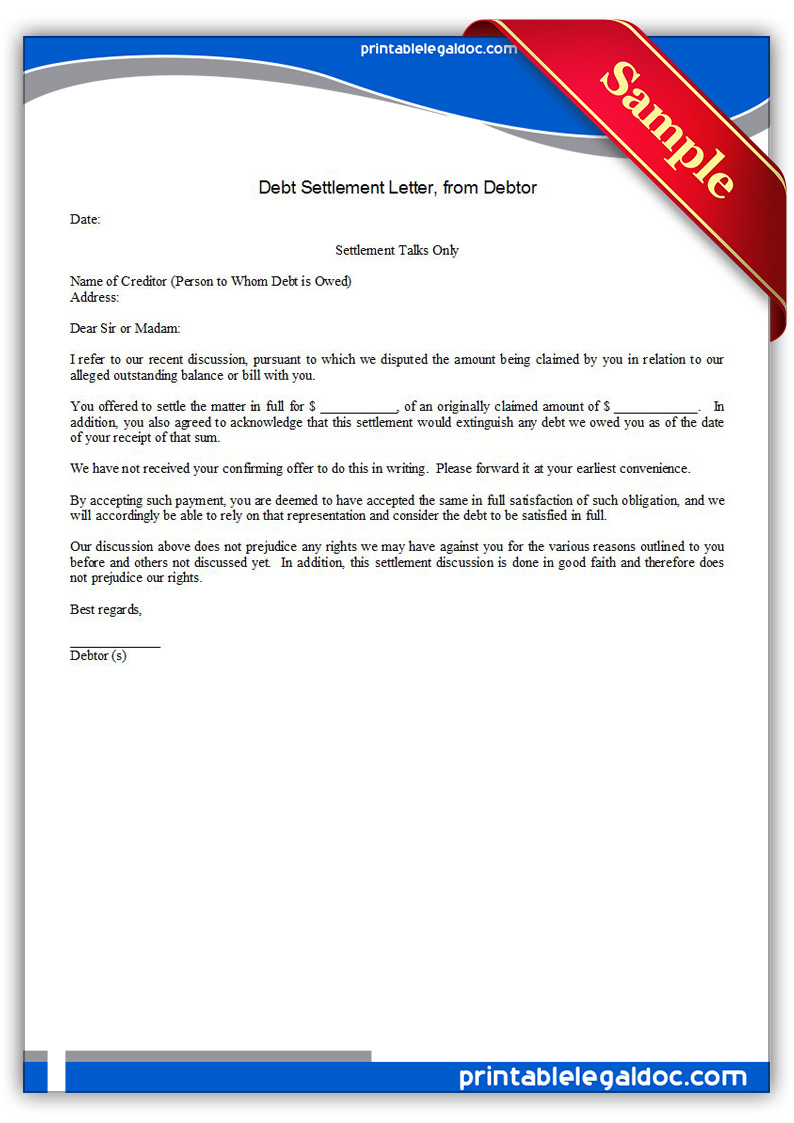
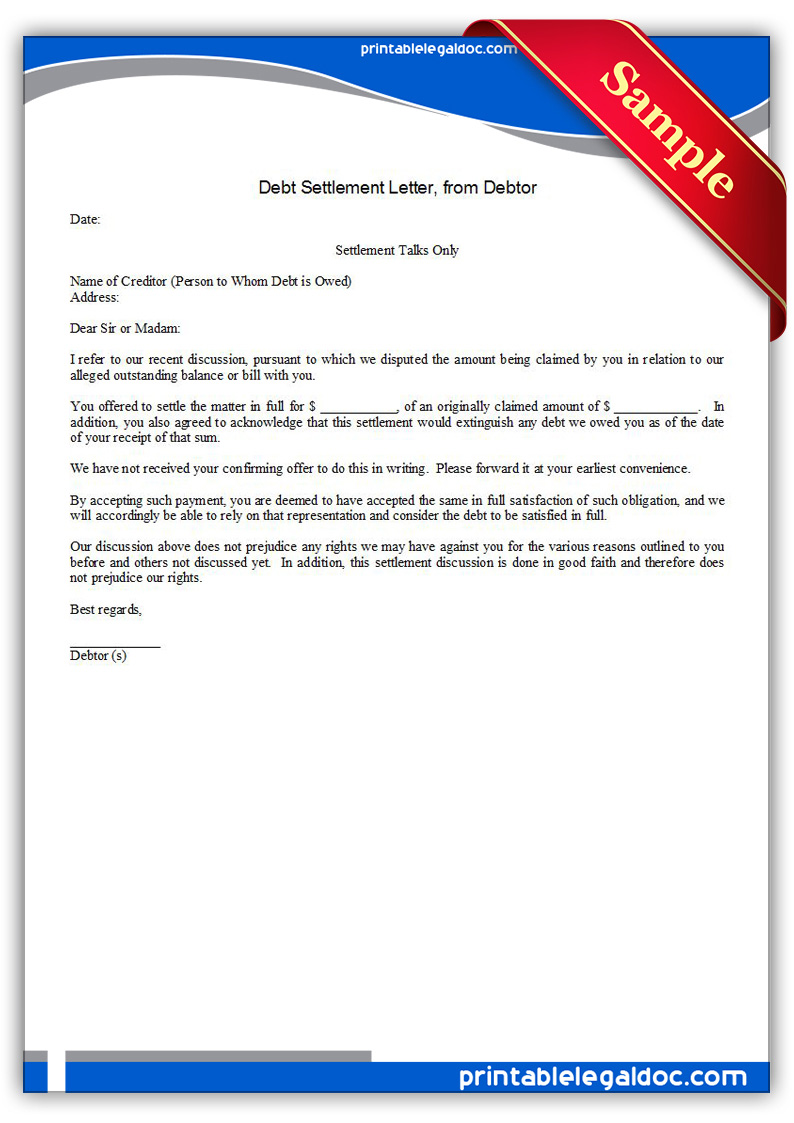
Debt Settlement Letter, from Debtor
Date:
Settlement Talks Only
Name of Creditor (Person to Whom Debt is Owed)
Address:Dear Sir or Madam:
I refer to our recent discussion, pursuant to which we disputed the amount being claimed by you in relation to our alleged outstanding balance or bill with you.
You offered to settle the matter in full for $ ___________, of an originally claimed amount of $ ____________. In addition, you also agreed to acknowledge that this settlement would extinguish any debt we owed you as of the date of your receipt of that sum.
We have not received your confirming offer to do this in writing. Please forward it at your earliest convenience.
By accepting such payment, you are deemed to have accepted the same in full satisfaction of such obligation, and we will accordingly be able to rely on that representation and consider the debt to be satisfied in full.
Our discussion above does not prejudice any rights we may have against you for the various reasons outlined to you before and others not discussed yet. In addition, this settlement discussion is done in good faith and therefore does not prejudice our rights.
Best regards,
_____________
Debtor (s)
Debt Settlement Letter, Debtor
Review ListThis review list is provided to inform you about the document in question and assist you in its preparation. Early efforts to settle a debt, especially with an offer of a 100% payout of the reduced sum, often result in big savings for the debtor as well as extinguishing a nasty dispute. The challenge is to avoid being trapped by sending in money in settlement that the debtor then claims is only for balance reduction. The way to avoid this is to require a clear settlement offer from the creditor prior to tendering the money. Also, you are always on stronger ground if they draft the agreement because they then have more of the burden of proof on them, as the drafter, than you do, as well as they are more comfortable, as a rule, with their own documents.
Debt reduction negotiations depend largely, as in most negotiations, on how strong the other side’s hand is. If they have good security, you cannot do much but you usually can do 10% to 20%. If they have no security, and are concerned about you as a credit risk, they may be willing to take a discount of 25% to 50%, or more. The other factor in the equation is “when” to make your pitch for a reduced offer. Generally the company credit people themselves are unwilling to do this though they will turn it over, often, to contingency credit people who will take a third off whatever is collected plus offer you a reduced amount.
In our experience, you can try with the original holder but remember you will get another crack at it with the collection people they assign the case to. As with all negotiations, it is a matter of how good you are at it and your ability to settle at a reasonable number for them as well as yourself.
1. The term “settlement talks only” has a specific meaning to most lawyers and collection people. Courts like settlement talks. If you say this is for Settlement Talks Only, most courts will not want to review the letter and, most importantly, not let the other side abuse you with it, if it comes down to trial. This is as much a custom as a legal fact or theory; therefore, you cannot rely on it absolutely but it should be at least somewhat helpful.
2. The other language is constructed so you do not get trapped into paying the settlement amount and then be dunned for the balance. The best way to achieve this is to get them to send you the offer themselves.
3. Many collection people try to whip up emotions to get you going and embarrass you into paying. This is a business for them. If they use this approach, it is only a tactic. Do not be put off. Don’t argue. Just be firm about what you can and cannot do. In this case, being weak is to come out better (that is, with a lower settlement percentage). Remember, they get paid on commission, as a rule, unless you are dealing with in-house people (and even then many do), so time is money for them. Interestingly, there is more pressure on them to go down to the final limit of their discount authority-than there is for you. If you gauge this correctly, you can estimate pretty well when they get there. Then you need to take the offer, if you can, and pay it. See our Negotiation Handbook disc, with various role playing scenarios and text, for more information on how to deal with negotiations-an always challenging subject!
Frequently Asked Questions
What is a debt settlement letter from a debtor?
A debt settlement letter from a debtor is a written communication sent by a debtor to a creditor to confirm the terms of a settlement discussion. It references a prior conversation where the creditor offered to accept a reduced amount to satisfy an outstanding debt. The letter requests that the creditor provide the offer in writing and states that payment will be made in full satisfaction of the obligation.
Why should a debtor send a debt settlement letter?
A debtor should send a debt settlement letter to obtain written confirmation of a settlement offer made verbally. This ensures that the creditor acknowledges that accepting the payment will extinguish the debt in full. Without written confirmation, the debtor may lack proof of the agreed terms.
What should be included in a debt settlement letter?
The letter should include the date, the creditor's name and address, and a reference to the prior discussion about the disputed amount. It should state the originally claimed amount and the agreed settlement amount, and request that the creditor forward a written confirming offer. It should also include a statement that acceptance of payment constitutes full satisfaction of the debt and a reservation of rights.
How do I write a debt settlement letter as a debtor?
To write a debt settlement letter as a debtor, start with a formal salutation and refer to your recent discussion with the creditor. Clearly state the original debt amount and the settlement amount you agreed upon, and request written confirmation of the offer. Include language that acceptance of the payment will satisfy the debt in full and that the discussion does not prejudice your rights.
What does 'settlement talks only' mean in a debt settlement letter?
The phrase 'settlement talks only' indicates that the letter is part of settlement negotiations and should not be treated as an admission of liability. It clarifies that the communication is made in good faith and does not prejudice any rights the debtor may have. This helps protect the debtor's position in case the settlement is not finalized.
Can a debt settlement letter extinguish a debt?
A debt settlement letter can extinguish a debt if the creditor agrees to accept a specific sum in full satisfaction of the obligation. The letter typically states that by accepting the payment, the creditor is deemed to have accepted it as full satisfaction. However, the debt is only extinguished once the creditor provides written confirmation and receives the payment.
What is the purpose of requesting a written confirming offer in a debt settlement letter?
The purpose of requesting a written confirming offer is to have a documented record of the creditor's agreement to settle the debt for a reduced amount. This written confirmation allows the debtor to rely on the representation that the debt will be satisfied in full upon payment. It also prevents future disputes about the terms of the settlement.
How does a debt settlement letter protect the debtor's rights?
A debt settlement letter protects the debtor's rights by including a statement that the settlement discussion does not prejudice any rights the debtor may have against the creditor. It also clarifies that the discussion is conducted in good faith and does not waive any defenses or claims. This ensures that the debtor can still pursue other legal remedies if necessary.
What happens if the creditor does not provide a written confirming offer?
If the creditor does not provide a written confirming offer, the debtor may not have proof of the agreed settlement terms. The debtor should follow up with the creditor to request the written confirmation as stated in the letter. Without it, the debtor may be hesitant to make payment, as the debt might not be considered satisfied in full.
Is a debt settlement letter legally binding?
A debt settlement letter itself is not necessarily legally binding until the creditor provides a written confirming offer and the debtor makes the agreed payment. The letter serves as a request for confirmation and outlines the terms under which the debt would be settled. Once both parties agree in writing and payment is made, the settlement can be binding.


Wonderful template. im going to print this form and will talk together with my family on what to edit.
Wow, thanks, The template looks professional done, printing myself one now.
Thank you very much 🙂 . I need this badly. Thank you im glad i found you on Google 🙂
Thank you! This document is very helpful to my business.
That is BRILLIANT!!! admin, you just made my year even more worth while for me!
This is so cool!! Im glad i didn’t join 1 membership site ,just to have one. Thank you, and great job
Great .Thanks for sharing this wonderful document.
Your my savior! Going to download this editable document now.
This is so amazing, thanks for sharing this word document to us.
Thanks admin, you rock!